
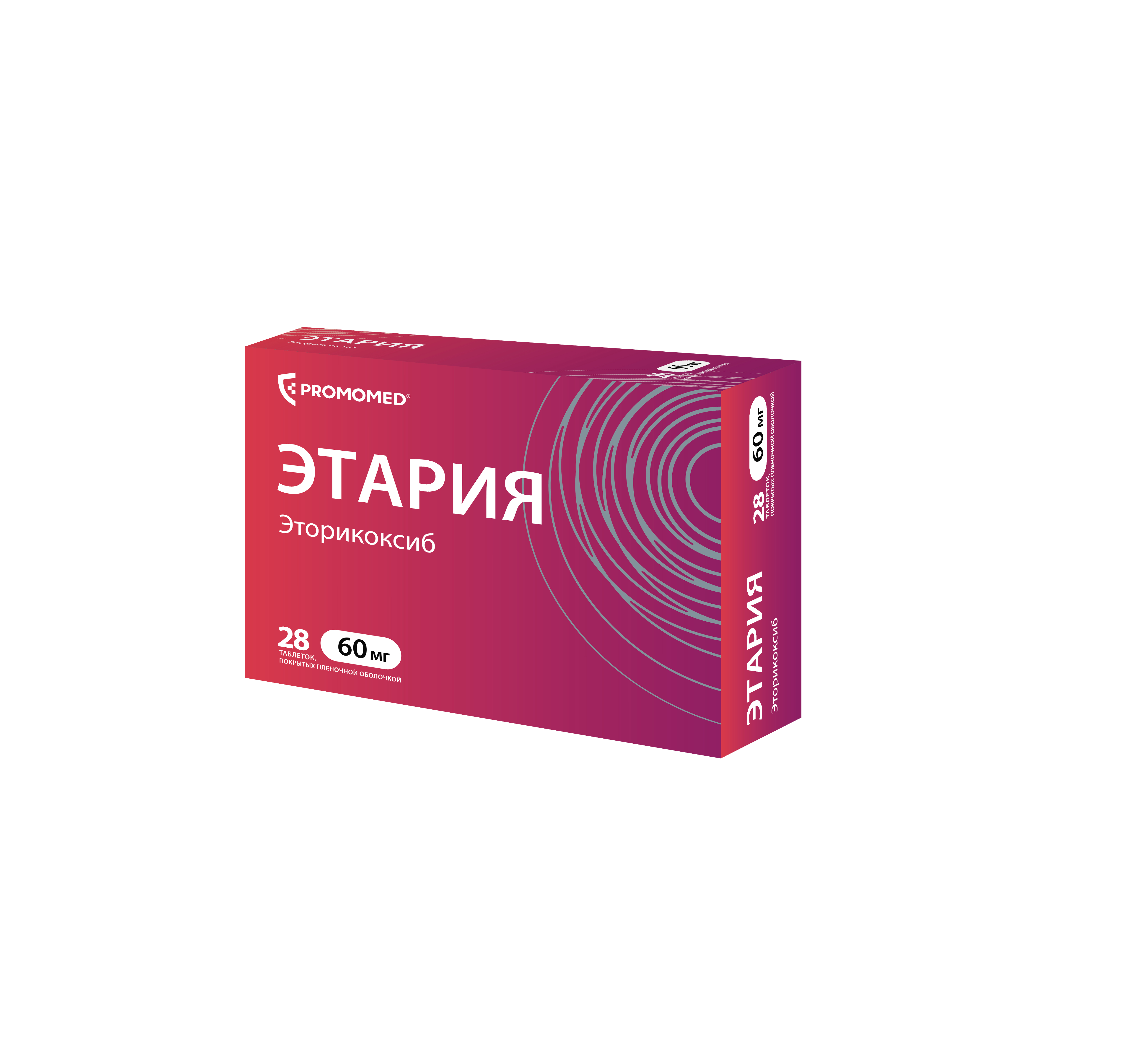

about the product
Film-coated tablets.
Etaria®, 60 mg, film-coated tablets
The drug is a film-coated tablet of green or gray-green color, round, biconvex. In the cross-section, the core is white or almost white.
Etaria®, 90 mg, film-coated tablets
The drug is a white film-coated tablet, round, biconvex. In the cross-section, the core is white or almost white.
Etaria®, 120 mg, film-coated tablets
The drug is a film-coated tablet of light green color, oval, biconvex, with a risk on one side. In the cross-section, the core is white or almost white.
Specifications
Name
Etaria®
Dosage form
FILM-COATED TABLETS
Nosological classification
Anti-inflammatory and antirheumatic drugs
INN
ETORICOXIB
Dosages
60 mg; 90 mg; 120 mg
ATC code
M01AH05
Active substance
etoricoxib
Pharmacotherapeutic group
Neurological drugs
use
Always take the drug in full accordance with the recommendations of your doctor.
If in doubt, consult your doctor.
Recommended dose
Etaria® should be taken at the lowest effective dose in the shortest possible course.
Joint disease (osteoarthritis)
The recommended dose is 30 mg once a day, if necessary, it can be increased to a maximum dose of 60 mg once a day.
Chronic inflammatory joint disease (rheumatoid arthritis)
The recommended dose is 60 mg once a day, if necessary, it can be increased to a maximum dose of 90 mg once a day.
Inflammatory disease of the spine and large joints (ankylosing spondylitis)
The recommended dose is 60 mg once a day, if necessary, it can be increased to a maximum dose of 90 mg once a day.
Chronic lower back pain
The recommended dose is 60 mg once a day. The duration of treatment should not exceed 12 weeks.
Conditions accompanied by acute pain
Etaria® should be used only during periods of acute pain.
Painful inflammation and redness of the joints associated with the deposition of salts in the joints (acute gouty arthritis)
The recommended dose is 120 mg once a day, which should be taken only during periods of acute pain lasting no more than 8 days.
Acute pain after dental surgery
The recommended dose is 90 mg once a day, which should be taken for a maximum duration of no more than 3 days.
Special patient groups
Elderly patients
No dose adjustment is required for elderly patients. As with other medications, if you are over 65 years of age, you should exercise caution.
Patients with liver diseases
If you have mild liver disease, you should not take more than 60 mg per day. If you have moderate liver disease, you should not take more than 30 mg per day.
Patients with kidney diseases
In the presence of mild to moderate kidney disease, no dose adjustment is required. In the presence of severe kidney disease, the use of the drug is contraindicated.
Use in children and adolescents
Do not give Etaria® to children and adolescents under 16 years of age.
Route and/or method of administration
Take the drug orally, regardless of the meal, with a small amount of water.
Recommended dose
Etaria® should be taken at the lowest effective dose in the shortest possible course.
Joint disease (osteoarthritis)
The recommended dose is 30 mg once a day, if necessary, it can be increased to a maximum dose of 60 mg once a day.
Chronic inflammatory joint disease (rheumatoid arthritis)
The recommended dose is 60 mg once a day, if necessary, it can be increased to a maximum dose of 90 mg once a day.
Inflammatory disease of the spine and large joints (ankylosing spondylitis)
The recommended dose is 60 mg once a day, if necessary, it can be increased to a maximum dose of 90 mg once a day.
Chronic lower back pain
The recommended dose is 60 mg once a day. The duration of treatment should not exceed 12 weeks.
Conditions accompanied by acute pain
Etaria® should be used only during periods of acute pain.
Painful inflammation and redness of the joints associated with the deposition of salts in the joints (acute gouty arthritis)
The recommended dose is 120 mg once a day, which should be taken only during periods of acute pain lasting no more than 8 days.
Acute pain after dental surgery
The recommended dose is 90 mg once a day, which should be taken for a maximum duration of no more than 3 days.
Special patient groups
Elderly patients
No dose adjustment is required for elderly patients. As with other medications, if you are over 65 years of age, you should exercise caution.
Patients with liver diseases
If you have mild liver disease, you should not take more than 60 mg per day. If you have moderate liver disease, you should not take more than 30 mg per day.
Patients with kidney diseases
In the presence of mild to moderate kidney disease, no dose adjustment is required. In the presence of severe kidney disease, the use of the drug is contraindicated.
Use in children and adolescents
Do not give Etaria® to children and adolescents under 16 years of age.
Route and/or method of administration
Take the drug orally, regardless of the meal, with a small amount of water.
Help
Package leaflet
Etaria® contains the active ingredient etoricoxib. Etaria® is a selective cyclooxygenase-2 (COX-2) inhibitor and belongs to the group of nonsteroidal anti-inflammatory drugs (NSAIDs). Etaria® helps to relieve pain and reduce swelling (inflammation) in joints and muscles.
Etaria® is used in adults and children over the age of 16 according to the following indications:
- treatment of chronic lower back pain.
- symptomatic therapy:
-chronic inflammatory joint disease (rheumatoid arthritis); -inflammatory disease of the spine and large joints (ankylosing spondylitis);
-
painful inflammation and redness of the joints associated with the deposition of salts in the joints (acute gouty arthritis).
- short-term treatment of moderate to severe acute pain after dental surgery.
You should never take Etaria® more than your doctor recommended. If you have taken more tablets of Etaria® than you should, seek medical attention immediately.
Like all medications, Etaria® may cause undesirable reactions, but not all of them do.
If the following serious adverse reactions occur, you should stop taking the drug and seek medical help immediately.
Serious adverse reactions that have been observed infrequently when taking Etaria® (may occur in no more than 1 person out of 100):
• decrease in the number of leukocytes in the blood, which perform the protective function of the body (leukopenia);
• a decrease in the number of platelets in the blood that perform the function of blood clotting (thrombocytopenia); redness of the skin (erythema), itching, the appearance of severely itchy pale blisters (urticaria), skin rash (hypersensitivity reactions);
• false images and phenomena, a deceptive sense of perception of the world (hallucinations);
• severe form of cardiac arrhythmia (atrial fibrillation);
• increasing shortness of breath, cough, chest pain, the appearance or increase of swelling of the feet (chronic heart failure);
• myocardial infarction;
• impaired cerebral circulation;
• short-term cerebrovascular accident (transient ischemic attack);
• a sharp increase in blood pressure (hypertensive crisis);
• Gastric ulcer and duodenal ulcer (gastroduodenal ulcer), stomach ulcer, including gastrointestinal perforations and bleeding;
• kidney failure/serious kidney problems.
Serious adverse reactions that have rarely been observed when taking Etaria® (may occur in no more than 1 person out of 1000):
• allergic reaction accompanied by a sharp decrease in blood pressure, body temperature, muscle spasm, pallor of the skin, disorders of the nervous system, confusion (anaphylactic shock);
• atypical reaction of the body, manifested by rapidly developing and increasing swelling of the skin, mucous membranes and subcutaneous fat (angioedema);
• hemorrhage into the skin or mucous membrane (ecchymosis);
• inflammation of the liver tissue (hepatitis);
• liver failure;
• jaundice;
• life-threatening diseases of the skin and mucous membranes (Stevens Johnson syndrome, toxic epidermal necrolysis).
The following adverse reactions may manifest themselves differently in each individual patient, and, if they occur, it is possible to consult a doctor.:
Very common (may occur in more than 1 person out of 10):
• Abdominal pain.
Often (may occur in no more than 1 person out of 10):
• inflammation of the alveolar bone tissue of the upper and lower jaw, which surrounds and supports the roots of the teeth (alveolar ostitis);
• edema (due to fluid retention);
• headache;
• dizziness;
• palpitations, abnormal heart rhythm (arrhythmia);
• increased blood pressure (hypertension);
• difficulty breathing (bronchospasm);
• constipation;
• increased gas formation in the intestine;
• inflammation of the gastric mucosa (gastritis);
• heartburn/return of stomach contents to the esophagus (gastroesophageal reflux);
• loose stools (diarrhea);
• dyspepsia/discomfort in the stomach (epigastrium);
• nausea;
• vomiting;
• inflammation of the mucous membrane of the esophagus (esophagitis);
• ulcers of the oral mucosa;
• increased activity of liver enzymes;
• weakness, flu-like syndrome.
Do not take Etaria®:
-
if you are allergic to etoricoxib or any other components of the drug (listed in section 6 of the leaflet).
if you have peptic ulcer of the stomach or duodenum in the acute stage or active gastrointestinal bleeding.
- if you have a complete or incomplete combination of chronic inflammation of the respiratory tract (bronchial asthma), inflammation of the nasal mucosa (acute rhinitis), recurrent overgrowth of the mucous membrane (polyposis) of the nose and paranasal sinuses and intolerance to acetylsalicylic acid or intolerance to other nonsteroidal anti-inflammatory drugs, as well as if you have experienced these conditions earlier.
- If you are pregnant or breastfeeding.
- if you have a serious liver disease.
- if you have a serious kidney disease.
- if you have inflammatory bowel diseases. if you have chronic heart failure.
- if you have an uncontrolled increase in blood pressure (arterial hypertension), in which blood pressure levels persistently exceed 140/90 mmHg. if you have confirmed coronary artery disease, peripheral arterial disease, and/or cerebrovascular disease. if you have lactase deficiency, lactose intolerance, or a disease associated with the inability of the intestine to digest sugar (glucose-galactose malabsorption). if you have a confirmed increase in blood potassium levels (hyperkalemia).
- if you have progressive kidney disease.
Tell your doctor that you are taking, have recently taken, or may start taking any other medications.
It is especially important to inform your doctor about the use of the following medications:
- oral anticoagulants (blood thinners), for example, warfarin;
- diuretics (diuretics);
- medications that help control high blood pressure and heart failure from the group of angiotensin converting enzyme (ACE) inhibitors and angiotensin II receptor blockers, such as enalapril and ramipril, losartan and valsartan; acetylsalicylic acid (concomitant administration with Etaria® increases the risk of developing gastric ulcer). If you are currently taking low doses of acetylsalicylic acid, you should consult your doctor. Do not take Etaria® with acetylsalicylic acid at the same time in doses exceeding those recommended for the prevention of cardiovascular diseases, as well as with other NSAIDs;
- cyclosporine or tacrolimus (drugs used to suppress the immune system);
- lithium (a drug used to treat certain types of depression);
- Methotrexate (a drug used to suppress the immune system, often used in the treatment of rheumatoid arthritis);
- oral contraceptives (birth control pills);
- hormone replacement therapy (combined use may increase the risk of adverse events);
- prednisone/prednisone (hormonal medications);
- digoxin (a drug for the treatment of heart failure and cardiac arrhythmias);
- ketoconazole (a drug for the treatment of thrush (vaginal candidiasis));
- voriconazole and miconazole (drugs for the treatment of fungal infections);
- salbutamol, tablets or an oral solution (a medication for the treatment of bronchial asthma);
- minoxidil (a drug for the treatment of high blood pressure);
- rifampicin (an antibiotic);
- drugs that lower stomach acidity (antacids)
Registration certificate holder
Russian Federation PROMOMED RUS LLC Address: 13 Mira Avenue, building 1, office 13, Moscow, 129090, Russia Phone: +7 (495) 640 25 28 E-mail: reception@promomed.pro
Manufacturer
JSC Biochemist, Russian Federation
Address: 15A Vasenko St., Saransk, 430030, Republic of Mordovia
An organization that accepts consumer claims
Russian Federation PROMOMED RUS LLC
Address: 13 Mira Avenue, building 1, office 13, Moscow, 129090, Russian Federation Phone: 8 800 222 95 63; 8 800 777 86 04 ( around the clock)
Email: hot_line@promomed.pro
Etaria® is contraindicated for children and adolescents under 16 years of age.
Dizziness and drowsiness have been reported in some patients taking Etaria®. Do not drive if you feel dizzy or sleepy. Refrain from using tools and working with mechanisms if you experience dizziness.
If you have an intolerance to certain sugars, consult your doctor before taking this medicine.
Do not take Etaria® if you are pregnant. Etoricoxib is contraindicated during pregnancy. If pregnancy occurs during the treatment period, stop taking the drug and consult your doctor.
The expiration date is the last day of the given month. Store at a temperature not exceeding 30 ° C.
our partners
Where to buy