
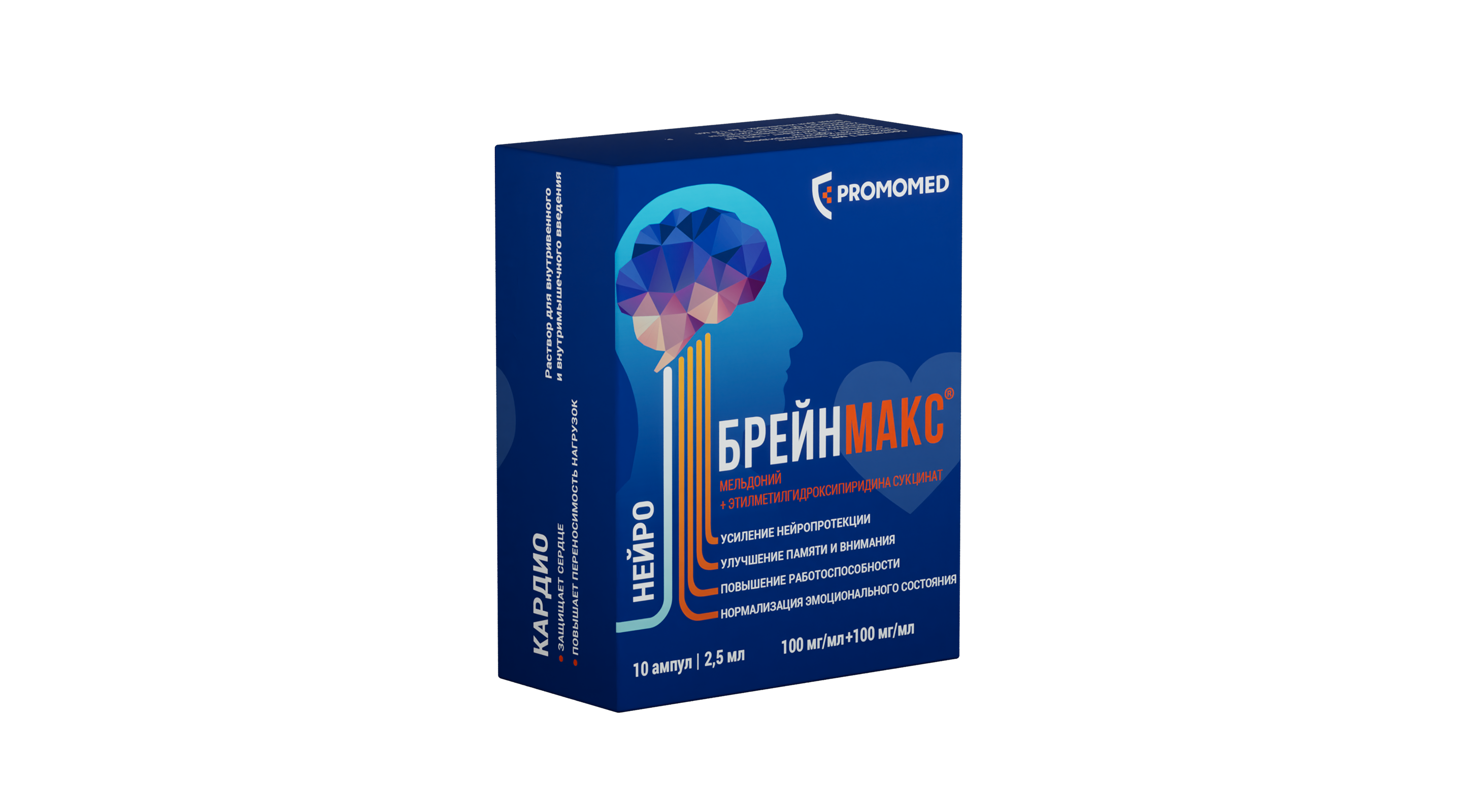
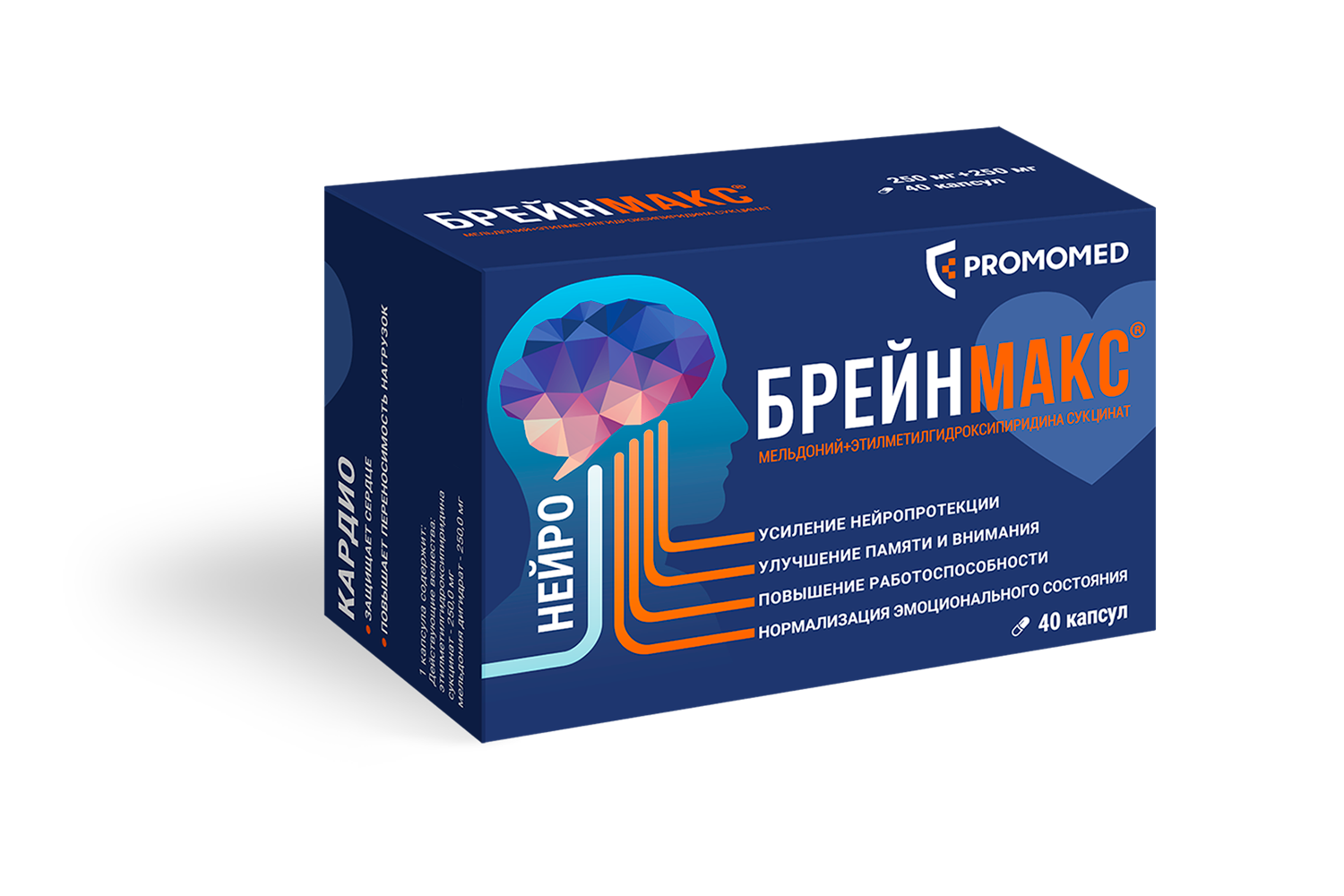


about the product
Solution for intravenous and intramuscular administration. Transparent liquid from light yellow to brownish yellow.
Original product
This product is a fully original Promomed product
On every original product you will see our brand label

Specifications
Name
BRAINMAX®
Dosage form
SOLUTION FOR INTRAVENOUS AND INTRAMUSCULAR ADMINISTRATION
Nosological classification
Other drugs for the treatment of diseases of the nervous system
INN
MELDONIUM+ETHYLMETHYLHYDROXYPYRIDINE SUCCINATE
Dosages
100 mg/ml+100 mg/ml
ATC code
N07XX
Active substance
Meldonium + ethylmethylhydroxypyridine succinate
Pharmacotherapeutic group
Neurological drugs
use
Always use the drug in full accordance with the recommendations of your doctor.
If in doubt, consult your doctor.
Recommended dose Due to the possible development of an excitatory effect, BRAINMAX® is recommended to be used in the morning. The method of administration and the duration of the course of therapy will be determined by the attending physician individually for you, depending on the indication, severity of the condition, etc. In acute disorders of cerebral circulation, including ischemic stroke, transient ischemic attack The drug is used for the first 10 days as part of complex therapy – 5 ml (500 mg + 500 mg) once a day intravenously, then for the next 14 days – 5 ml (500 mg + 500 mg) 2 times a day intramuscularly.
In case of dyscirculatory encephalopathy in the decompensation phase
The drug is administered 2.5 ml (250 mg + 250 mg) intravenously 2 times a day for 14 days. Then intramuscularly 2.5 ml 1 time per day for 14 days.
In chronic disorders of the blood supply to the brain and in the treatment of the consequences of acute cerebrovascular accident
The drug is administered intramuscularly or intravenously 2.5 ml (250 mg + 250 mg) 2 times a day for 10 days. Then the therapy is continued with BRAINMAX®, capsules, orally 2 capsules (500 mg + 500 mg) 1 time a day or 1 capsule of the drug (250 mg + 250 mg) 2 times a day. The total course of treatment is 4-6 weeks.
For cognitive disorders and encephalopathy
The drug is administered intramuscularly 2.5 ml (250 mg + 250 mg) once a day for 14-30 days.
With reduced working capacity, asthenic conditions, mental and physical overloads
The drug is administered intramuscularly in 5 ml (500 mg + 500 mg) once a day for 10-14 days. If necessary, the treatment is repeated after consultation with a doctor in 2-3 weeks.
Route and method of administration BRAINMAX® is administered by intramuscular injection or intravenous prolonged administration (infusion).
If in doubt, consult your doctor.
Recommended dose Due to the possible development of an excitatory effect, BRAINMAX® is recommended to be used in the morning. The method of administration and the duration of the course of therapy will be determined by the attending physician individually for you, depending on the indication, severity of the condition, etc. In acute disorders of cerebral circulation, including ischemic stroke, transient ischemic attack The drug is used for the first 10 days as part of complex therapy – 5 ml (500 mg + 500 mg) once a day intravenously, then for the next 14 days – 5 ml (500 mg + 500 mg) 2 times a day intramuscularly.
In case of dyscirculatory encephalopathy in the decompensation phase
The drug is administered 2.5 ml (250 mg + 250 mg) intravenously 2 times a day for 14 days. Then intramuscularly 2.5 ml 1 time per day for 14 days.
In chronic disorders of the blood supply to the brain and in the treatment of the consequences of acute cerebrovascular accident
The drug is administered intramuscularly or intravenously 2.5 ml (250 mg + 250 mg) 2 times a day for 10 days. Then the therapy is continued with BRAINMAX®, capsules, orally 2 capsules (500 mg + 500 mg) 1 time a day or 1 capsule of the drug (250 mg + 250 mg) 2 times a day. The total course of treatment is 4-6 weeks.
For cognitive disorders and encephalopathy
The drug is administered intramuscularly 2.5 ml (250 mg + 250 mg) once a day for 14-30 days.
With reduced working capacity, asthenic conditions, mental and physical overloads
The drug is administered intramuscularly in 5 ml (500 mg + 500 mg) once a day for 10-14 days. If necessary, the treatment is repeated after consultation with a doctor in 2-3 weeks.
Route and method of administration BRAINMAX® is administered by intramuscular injection or intravenous prolonged administration (infusion).
Help
Package leaflet
BRAINMAX® has a complex effect on the nervous system: it activates metabolic processes, improves microcirculation and blood supply to the brain, and protects cell membranes from the damaging effects of free radicals (molecules or atoms that can damage healthy cells). In conditions of a lack of oxygen supply, the drug helps restore the processes of oxygen delivery and consumption by cells, and increase energy production. In acute blood supply disorders, it increases the survival of brain cells. Increases the body's resistance to various damaging factors.
BRAINMAX® improves memory and attention (cognitive functions), normalizes emotional state, reduces symptoms of asthenia (chronic fatigue, sleep disorders, headache and dizziness, anxiety), mental and physical overexertion, increases efficiency, increases the ability to adapt to severe mental and physical stress.
BRAINMAX® is indicated for use in adults over the age of 18 as part of the complex therapy of acute and chronic cerebral circulatory disorders.:
- impaired blood flow to any part of the brain (ischemic stroke (cerebral infarction)), temporary disruption of blood flow to any part of the brain (transient ischemic attack);
- decreased brain functions due to chronic nutritional deficiency of brain tissues (dyscirculatory encephalopathy), chronic malnutrition of brain tissues (cerebrovascular insufficiency);
- mild cognitive disorders (decreased memory and mental performance) of atherosclerotic origin (due to the deposition of cholesterol plaques on the walls of blood vessels supplying the brain);
- reduced working capacity; mental and physical overload (including in athletes).
Decreased blood pressure, accompanied by headache, tachycardia, dizziness, and general weakness. Drowsiness, insomnia.
Discontinue use of BRAINMAX® and seek immediate medical attention if one of the following signs of an allergic reaction occurs: angioedema, which has been observed rarely (may occur in no more than 1 person out of 1000):
• swelling of the face, neck, larynx;
• difficulty breathing;
• difficulty swallowing.
Other possible adverse reactions that may occur when using BRAINMAX®:
Often – may occur in no more than 1 person out of 10
• digestive disorders in the upper gastrointestinal tract, accompanied by heartburn, abdominal heaviness, nausea (dyspeptic symptoms);
• headache.
Rare – may occur in no more than 1 person out of 1000
• allergic reactions (redness of the skin (hyperemia), skin rash, urticaria, itching, swelling);
• decrease or increase in blood pressure.
Very rare – may occur in no more than 1 person out of 10,000
• increased heart rate (tachycardia);
• dry mouth, nausea, pain, burning and discomfort in the upper abdomen (epigastric region), heartburn, bloating (flatulence), frequent loose stools (diarrhea);
• drowsiness.
Do not use BRAINMAX® in the following cases::
-
If you are allergic to meldonium or ethylmethylhydroxypyridine succinate, or any other components of the drug (listed in section 6 of the leaflet).
- If you have acute liver failure.
- If you have acute renal failure.
- If you have increased intracranial pressure (with impaired venous outflow and intracranial tumors).
- If you are pregnant or breastfeeding.
- If you are under 18 years old
The drug BRAINMAX® enhances the effect:
• drugs that dilate the blood vessels of the heart (coronarodilating drugs), including nitrates*;
• some medications that lower blood pressure (antihypertensive agents)*;
• drugs that increase the efficiency of the heart (cardiac glycosides)*;
* Due to the combined use, palpitations (tachycardia) and a decrease in blood pressure (hypotension) may develop, therefore, caution should be exercised when combined with nitroglycerin (for sublingual use) and antihypertensive agents (especially alpha-blockers and short-acting forms of nifedipine).
• Benzodiazepine drugs (for the treatment of mental disorders);
• antidepressants;
• anxiolytics (drugs for the treatment of anxiety);
• antiepileptic drugs, for example, carbamazepine (for the treatment of epilepsy and seizures);
• levodopa drugs (for the treatment of Parkinson's disease).
BRAINMAX® can be combined with medications:
• long-acting (prolonged forms) that improve oxygen supply to the heart (nitrates);
• improving oxygen saturation of the heart (antianginal drugs);
• reducing the blood coagulation system (anticoagulants);
• preventing platelet bonding (antiplatelet agents);
• for the treatment of cardiac arrhythmias (with antiarrhythmic drugs);
• diuretics (diuretics);
• airway dilators (bronchodilators).
Registration certificate holder
JSC Biochemist, Russian Federation
15A Vasenko St., Saransk, Republic of Mordovia, 430030
Manufacturer
JSC Biochemist, Russian Federation
Address: 15A Vasenko str., Saransk, 430030, Republic of Mordovia
Phone number: +7 (8342) 38 03 68
Email: biohimic@promomed.pro
Internet address: promomed.ru
An organization that accepts consumer claims
JSC Biochemist, Russian Federation
Address: 15A Vasenko str., Saransk, 430030, Republic of Mordovia
Phone number: 8 800 222 95 63; 8 800 777 86 04 ( around the clock)
Email: hot_line@promomed.pro
Do not store at temperatures above 25 °C. Store in the original packaging (pack) to protect from light.
During the period of taking the drug, care should be taken when working that requires increased concentration of attention and speed of psychomotor reactions (driving vehicles, mechanisms, etc.).
available product options
our partners
Where to buy