
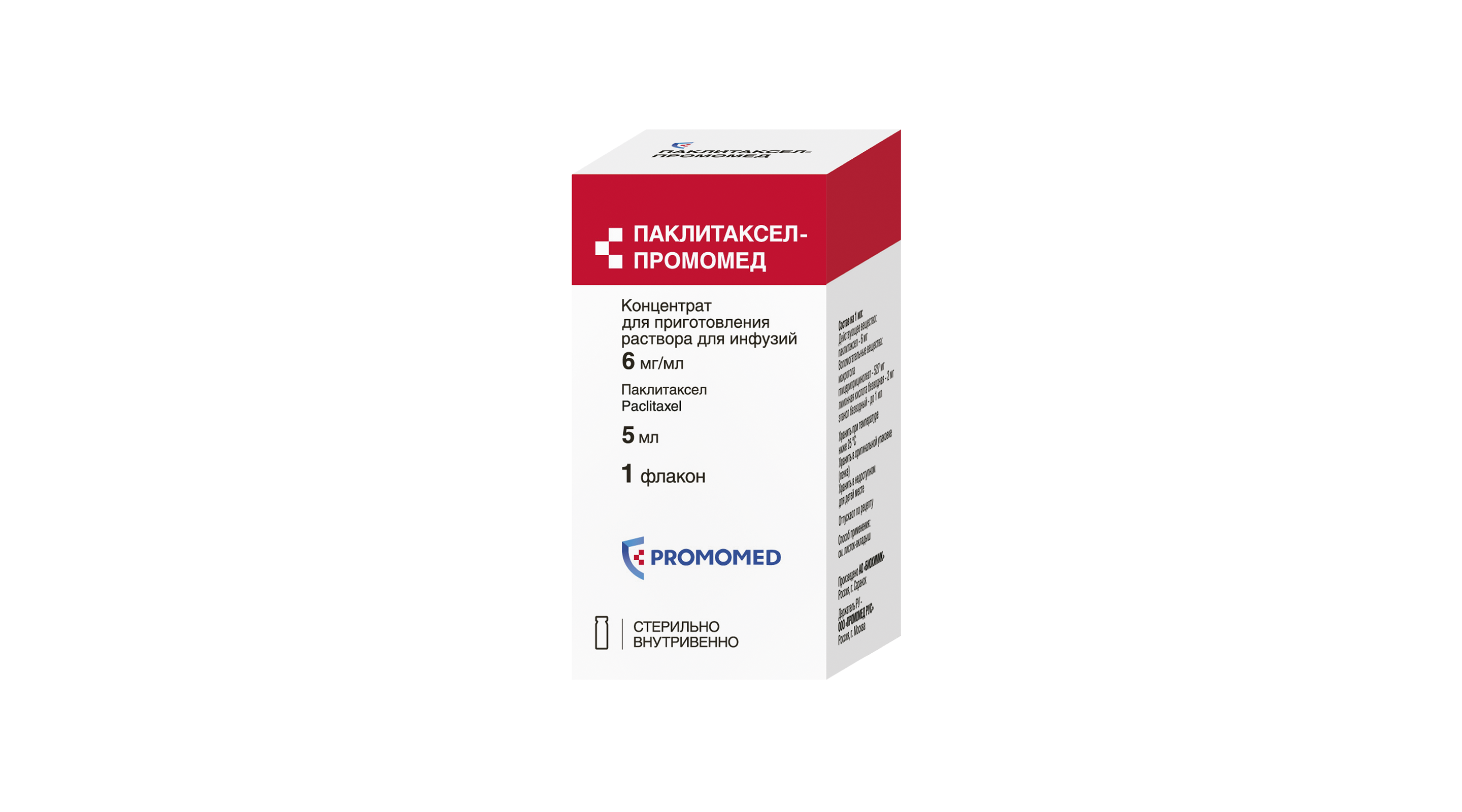

about the product
Transparent viscous liquid from colorless to light yellow in color.
Specifications
use
Recommended dose:
The dose and regimen of Paclitaxel-Promomed is selected by your doctor individually, depending on your diagnosis, the severity of the disease, and the results of a blood test. During treatment, the dose of the drug can be adjusted by the doctor depending on the results of a blood test, the tolerability of the drug, and the development of adverse reactions.
In order to avoid severe allergic reactions (hypersensitivity reactions), premedication and pre-administration of hormonal and antihistamines (glucocorticosteroids, H1 and H2-histamine receptor blockers) will be performed before the administration of Paclitaxel-Promomed.
During therapy, the doctor will regularly perform blood tests for you to monitor
undesirable reactions.
You will receive Paclitaxel-Promomed as monotherapy or in combination with another anticancer drug.
Patients with impaired liver function
If you have liver failure, your doctor will decide whether to change the dose of the drug.
The way and method of administration
The use of the drug will be carried out under the supervision of a doctor who has experience working with antitumor chemotherapeutic drugs.
You will receive Paclitaxel-Promomed by intravenous infusion (slow injection of the drug into a vein). The infusion can last 3 or 24 hours, the required duration of the infusion will be determined by your doctor.
Duration of therapy
The doctor will inform you about the number of scheduled therapy courses.
Help
Package leaflet
The drug Paclitaxel-Promomed contains the active substance paclitaxel and belongs to the group of medicines "anticancer agents, alkaloids of plant origin and other natural substances, taxanes". It has antitumor effect and is used to treat oncological diseases. Paclitaxel prevents the division of tumor cells, which leads to their death.
The drug Paclitaxel-Promomed is used in adults over the age of 18 for the treatment of:
Ovarian cancer
• as a first-line therapy in combination with platinum preparations in patients with advanced ovarian cancer or with a residual tumor (more than 1 cm) after initial laparotomy;
• as a 2nd-line therapy in patients with metastatic ovarian cancer after
standard therapy, which did not lead to a positive result.
Breast cancer
• as adjuvant therapy (i.e. therapy that is performed in addition to primary therapy to enhance its effect) in patients with lymph node metastases after standard combined treatment;
• as a first-line therapy in patients with late-stage cancer or metastatic cancer after relapse of the disease (resumption of the disease) within 6 months after the start of adjuvant therapy, with the inclusion of anthracycline drugs in the absence of contraindications for their use;
• as a first-line therapy in patients with advanced stage cancer or metastatic breast cancer in combination with anthracycline drugs in the absence of contraindications for their use, or in combination with trastuzumab in patients with immunohistochemically confirmed 2+ or 3+ expression levels of HER-2 (a genetic marker of the disease);
• as a 2nd-line therapy in patients with advanced cancer or metastatic cancer with disease progression after combined chemotherapy. Previous therapy should include anthracycline preparations in the absence of contraindications for their use.
Non-small cell lung cancer (NSCLC)
• as first-line therapy in combination with cisplatin or as monotherapy in patients who do not plan to undergo surgery and/or radiation therapy.
Kaposi's sarcoma caused by AIDS
• as a 2nd-line therapy.
Treatment with Paclitaxel-Promomed is selected and monitored by a doctor, so the likelihood that you will receive more or less of it than you need is minimal. However, if you have any doubts, consult your doctor.
Like all medications, Paclitaxel-Promomed can cause undesirable reactions, but they do not occur in everyone.
It is important that you inform your doctor about any adverse reactions that occur so that he can take appropriate measures (for example, temporarily suspend or cancel treatment, change the dose and duration of the drug, and prescribe additional therapy).
Some adverse reactions can be serious and life-threatening.
They can occur very often (in more than 1 person out of 10):
• bleeding
• muscle weakness, limb twitching, loss of balance and coordination of movements (signs of peripheral neuropathy)
• repeated vomiting or diarrhea, which can lead to dehydration
They may occur infrequently (in no more than 1 patient out of 100):
• decreased blood pressure (BP), rapidly increasing swelling of the skin, mucous membranes and subcutaneous tissue (angioedema), shortness of breath and bluish skin tone (impaired respiratory function), redness and itching throughout the body (generalized urticaria), back pain, chills – all these symptoms may be signs of a serious allergic reaction
• an increase in body temperature above 38-39 ° C, which is poorly reduced by antipyretic drugs, a decrease in blood pressure below the operating value, an increase in pulse rate, an increase in the frequency of respiratory movements, a sharp decrease in the amount of urine excreted, general weakness, exhaustion, impaired consciousness or behavior, seizures (signs
septic shock)
• severe chest pain radiating to the neck, arms, and shoulder blades, shortness of breath, sudden pressure surges, pallor of the skin and mucous membranes, increased sweating, anxiety, weakness (signs of a myocardial infarction)
• swelling, numbness of the hands and feet, redness of the skin, a feeling of heat (signs of venous thrombosis)
(For more information about all possible adverse reactions, see the leaflet)
Do not use Paclitaxel-Promomed:
- if you are allergic to paclitaxel or any other component of the drug listed in section 6 of the leaflet;
- if you have an initial neutrophil count of less than 1,500 cells in one microliter of blood if you have a diagnosis of a solid tumor (detected by a blood test);
- if you have an initial or registered neutrophil count of less than 1,000 cells in one microliter of blood with a diagnosis of Kaposi's sarcoma caused by AIDS (detected by a blood test); if you have concomitant serious uncontrolled infections with a diagnosis of Kaposi's sarcoma.
Tell your doctor that you are taking, have recently taken, or may start taking any other medications.
Tell your doctor if you are taking any of the following medications:
- Substrates of CYP2C8 and CYP3A4 isoenzymes
- Inducers of CYP2C8 and CYP3A4,
- Inhibitors of CYP2C8 and CYP3A4
- Paclitaxel (used in the treatment of cancer).
- Doxorubicin (used in antitumor therapy).
Registration certificate holder
JSC Biochemist, Russian Federation
15A Vasenko St., Saransk, Republic of Mordovia, 430030
Manufacturer
JSC Biochemist, Russian Federation
Address: 15A Vasenko str., Saransk, 430030, Republic of Mordovia
Phone number: +7 (8342) 38 03 68
Email: biohimic@promomed.pro
Internet address: promomed.ru
An organization that accepts consumer claims
JSC Biochemist, Russian Federation
Address: 15A Vasenko str., Saransk, 430030, Republic of Mordovia
Phone number: 8 800 222 95 63; 8 800 777 86 04 ( around the clock)
Email: hot_line@promomed.pro
Keep the drug out of the reach of the child so that the child cannot see it. Do not use the drug after the expiration date (shelf life) indicated on the carton after "Good before". The expiration date is the last day of the given month. Store at temperatures below 25 ° C. Store in the original packaging (pack/box).
Do not use the drug in children aged 0 to 18 years, as efficacy and safety have not been established.
If you are pregnant or breastfeeding, think you are pregnant, or are planning to become pregnant, consult your doctor before using the drug. Do not use Paclitaxel-Promomed if you are pregnant. Consult with your doctor before use.
our partners