
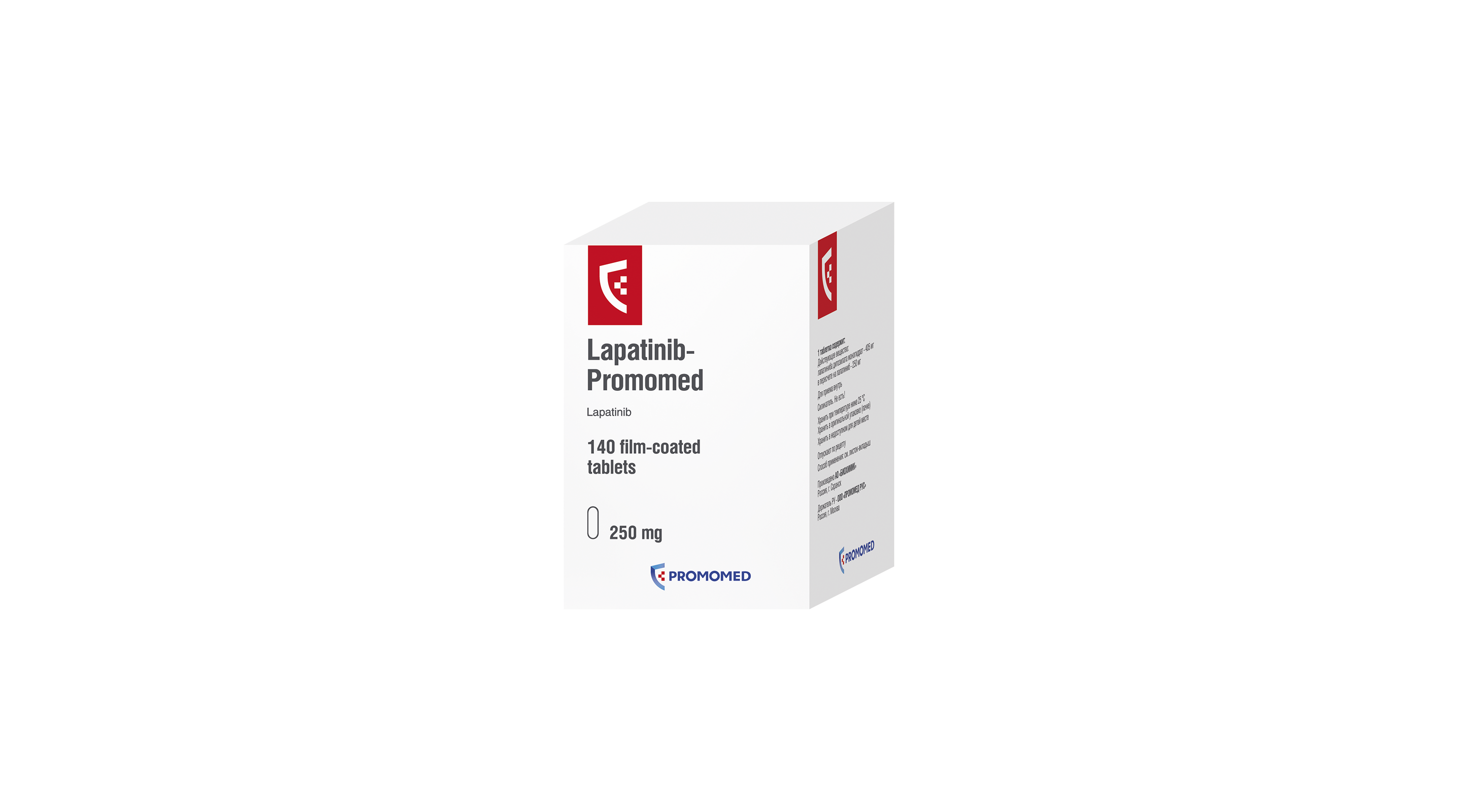

about the product
The drug Lapatinib-Promomed is a film-coated tablet from light yellow to yellow, oval, biconvex.
In the cross-section, the core is yellow or yellow with a greenish tinge.
In the cross-section, the core is yellow or yellow with a greenish tinge.
Specifications
Name
Lapatinib-Promomed
Dosage form
Film-coated tablets
Nosological classification
Antitumor drugs
INN
LAPATINIB
Dosages
250 mg
ATC code
L01EH01
Active substance
lapatinib
Pharmacotherapeutic group
Cancer drugs
use
Always take Lapatinib Promomed in full accordance with the recommendations of your doctor. If in doubt, consult your doctor.
Recommended dose
Your doctor will tell you exactly how many tablets of Lapatinib Promomed to take.
Patients taking Lapatinib-Promomed in combination with capecitabine
The usual daily dose of the drug is 1250 mg (5 film-coated tablets) once a day during combination therapy with capecitabine.
Patients taking Lapatinib-Promomed in combination with trastuzumab
The usual daily dose of the drug is 1000 mg (4 film-coated tablets) once a day during combination therapy with trastuzumab.
Patients taking Lapatinib-Promomed in combination with an aromatase inhibitor
The usual daily dose of the drug is 1,500 mg (6 film-coated tablets) once a day during combination therapy with the inhibitor
aromatases.
Your doctor will tell you the dose and time of taking capecitabine, trastuzumab, or an aromatase inhibitor.
Depending on the response to treatment with Lapatinib-Promomed, the presence of heart, lung or liver diseases, severe episodes of diarrhea or skin reactions during treatment with Lapatinib-Promomed, your doctor may prescribe you a lower dose or temporarily discontinue treatment.
Route and method of administration
Take Lapatinib Promomed once a day at least 1 hour before or 1 hour after meals.
Take the usual daily dose of Lapatinib Promomed at the same time.
Taking Lapatinib Promomed at the same time every day will help you not to miss taking the appropriate dose.
Duration of therapy
Continue taking Lapatinib-Promomed for the period specified by your doctor.
This is a long-term treatment that can last several months or years. Your doctor will regularly monitor your condition to make sure that the treatment provides the desired effect.
If you have any questions about the duration of treatment with Lapatinib-Promomed, talk to your doctor.
Help
Package leaflet
In breast cancer, the amount of a protein called the human epidermal growth factor (HER2) receptor may increase in tumor cells. As a result, cancer cells begin to grow and divide intensively. The drug Lapatinib-Promomed blocks the action of this protein and thus slows down the growth and division of cancer cells, and it is also able to destroy them. If there is no improvement or you feel worse, you should consult a doctor.
Lapatinib-Promomed is indicated for use in adults over the age of 18 for the treatment of breast cancer that has spread beyond the original tumor or to other organs (locally advanced or metastatic breast cancer) and in which the amount of a certain protein increases in cancer cells (HER2 overexpression). Lapatinib-Prommed is taken together with one of the following antitumor drugs: in combination with capecitabine (if you have previously been treated for metastatic breast cancer using trastuzumab, anthracyclines and taxanes); with trastuzumab (if you do not have certain hormone receptors and have previously been treated for metastatic breast cancer using trastuzumab together with other antitumor drugs); with aromatase inhibitors (if you have a period of cessation of the menstrual cycle due to the loss of ovarian function (postmenopause), and at the same time a hormone-sensitive variant of breast cancer has been identified
glands).
If you have taken too much of the drug Lapatinib-Promomed, immediately seek advice from your doctor or hospital. Show the packaging of the drug Lapatinib-Promomed. Medical intervention may be required.
Like all medications, Lapatinib-Promomed can cause undesirable reactions, but they do not occur in everyone.
Some adverse reactions can be serious.
If you experience serious adverse reactions, stop taking this medication and report them to your doctor immediately.
Very often, they can occur in more than 1 person out of 10
• fever, sore throat, frequent infections as signs of low white blood cell count (leukopenia)
• pallor of the skin, weakness, dizziness, tinnitus as signs of low hemoglobin and red blood cell levels (anemia)
Often – may occur in no more than 1 person out of 10
• irregular heartbeat and shortness of breath (decreased left ventricular ejection fraction)
Infrequently – may occur in no more than 1 person out of 100
Itching, yellow eyes or skin (jaundice), dark urine, or pain/discomfort in the upper right side of the stomach (hepatotoxicity or hyperbilirubinemia)
• cough or shortness of breath (interstitial lung disease and/or pneumonitis)
Rare – may occur in no more than 1 person out of 1,000
• skin rash (including itchy, bumpy rash), redness of the skin, urticaria, uncharacteristic wheezing, coughing or difficulty breathing, swollen eyelids, lips, face or tongue, bluish coloration of lips, tongue or skin, muscle or joint pain, fainting, dizziness, loss of consciousness (fainting) hypotension (signs of severe allergic reactions)
(For more information about all possible adverse reactions, see the leaflet)
Do not take Lapatinib Promomed in the following cases::
- If you are allergic to lapatinib or to any of the other components of the drug listed in section 6 of the leaflet.
Be sure to tell your doctor if you are taking any of the following medications:
• medications used to treat infections such as erythromycin, telithromycin, ketoconazole, itraconazole, posaconazole, voriconazole, rifabutin, rifampicin
• medications used to treat human immunodeficiency virus (HIV), such as ritonavir, saquinavir
• medications used to treat diseases of the digestive system, such as cisapride
• medications used to treat peptic ulcer or digestive disorders that reduce stomach acidity, such as esomeprazole
• medications used to treat heart disease, such as quinidine or digoxin
• medications used to treat hypertension or
angina pectoris, such as verapamil
• medications used to treat high cholesterol, such as rosuvastatin
• medications used to treat diabetes, such as repaglinide
• medications used to treat seizures, such as phenytoin or carbamazepine
• Medications used to treat mental illness, such as pimozide
• medications used to treat depression, such as nefazodone or the herbal preparation St. John's wort (also known as Hypericum perforatum)
• medications used for sedation before surgery (anesthesia), such as midazolam
• medications used to prevent organ transplant rejection, such as cyclosporine
• medications used to treat cancer, such as topotecan, paclitaxel, docetaxel, or irinotecan
The holder of the registration certificate
JSC Biochemist, Russian Federation
15A Vasenko St., Saransk, 430030, Republic of Mordovia
Manufacturer
JSC Biochemist, Russian Federation
Address: 15A Vasenko St., Saransk, 430030, Republic of Mordovia
Phone: +7 (8342) 38 03 68
Email: biohimic@promomed.pro
Internet address: promomed.pro
The organization that accepts consumer claims
JSC Biochemist, Russian Federation
Address: 15A Vasenko St., Saransk, 430030, Republic of Mordovia
Phone number: 8 800 222 95 63; 8 800 777 86 04 ( around the clock)
Email: hot_line@promomed.pro
Keep the drug out of the reach of the child so that the child cannot see it. Do not take the drug after the expiration date (shelf life) indicated on the package. The expiration date is the last day of the given month.
Lapatinib-Promomed is not indicated for use in patients under the age of 18.
The effect on the ability to drive vehicles and engage in other activities requiring increased concentration and speed of psychomotor reactions has not been studied. Based on the mechanism of action of the drug Lapatinib-Promomed, it is impossible to assume an adverse effect on such activities, but the general condition should be taken into account. Care must be taken when driving vehicles and engaging in other potentially dangerous activities that require increased concentration of attention and speed of psychomotor reactions.
our partners
Where to buy