about the product
The tablets are oval, biconvex, coated in white or almost white with a risk on one side. Two layers are visible on the cross section. The color of the core without the shell is white or almost white.
Original product
This product is a fully original Promomed product
On every original product you will see our brand label
Specifications
Name
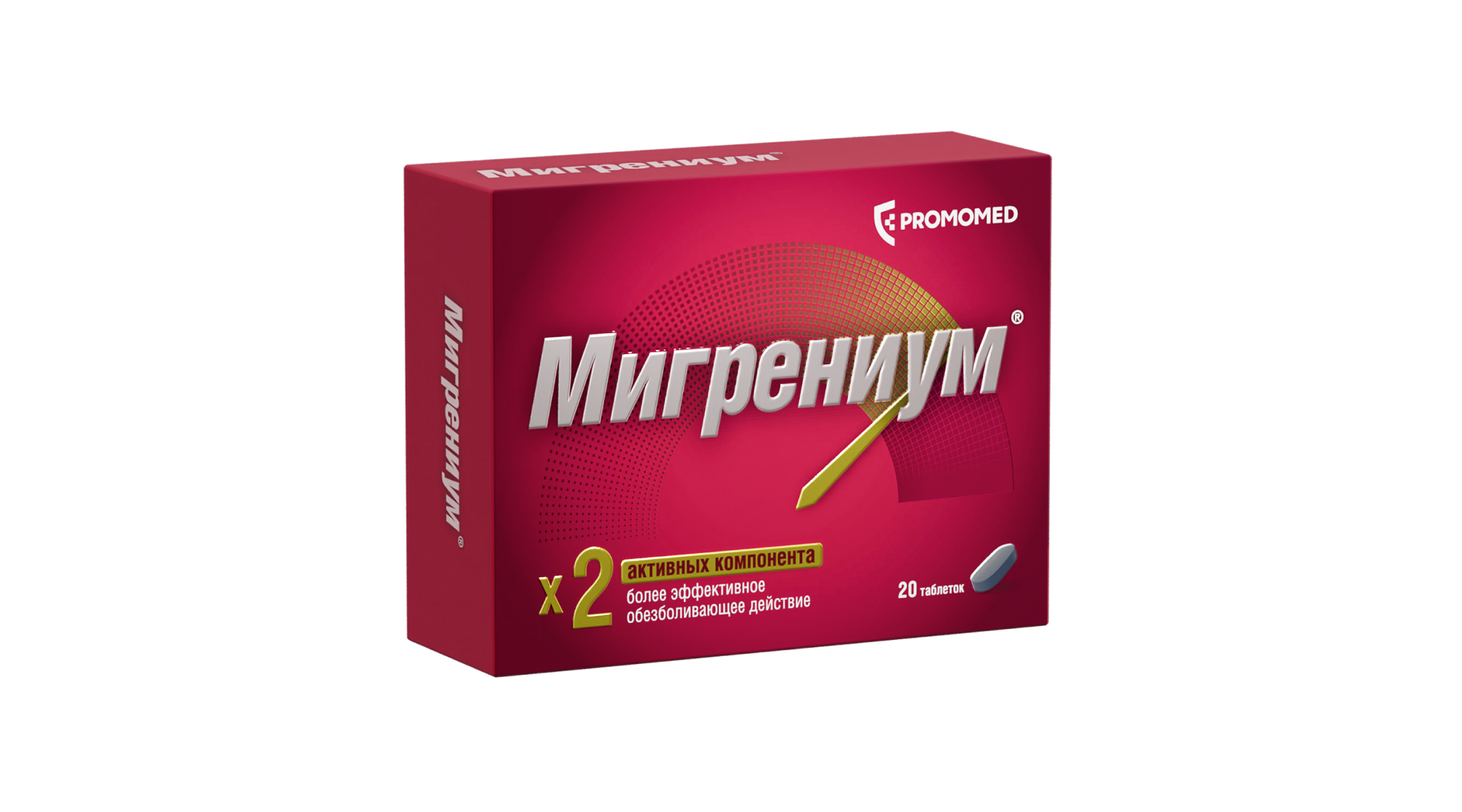
Migrenium®
Dosage form
Film-coated tablets
Nosological classification
Analgesics
INN
Caffeine+Paracetamol
Dosages
65 mg + 500 mg
ATC code
N02BE51
Active substance
paracetamol – 0.500 g, caffeine – 0.065 g
Pharmacotherapeutic group
Neurological drugs
use
Inside, adults and children over 12 years of age - 2 tablets 4 times a day with an interval of at least 4 hours. The maximum daily dose is 8 tablets.
The duration of use is no more than 3 days (as an antipyretic) and no more than 5 days (as an analgesic).
The duration of use is no more than 3 days (as an antipyretic) and no more than 5 days (as an analgesic).
Help
Package leaflet
Migrenium is a combined drug, the effect of which is determined by the components that make up its composition.
Caffeine has a psychostimulating (stimulates the psychomotor centers of the brain), analeptic effect, enhances the effect of analgesics, eliminates drowsiness and fatigue, increases physical and mental performance. It affects the cardiovascular system: increases the frequency and strength of heart contractions (HR), increases blood pressure (BP) with hypotension (does not change the normal). Dilates the bronchi, biliary tract, blood vessels of skeletal muscles, heart, kidneys, narrows the vessels of the abdominal cavity. Reduces platelet aggregation. It stimulates the secretion of gastric glands, increases basal metabolism, and has a moderate diuretic effect.
Paracetamol has antipyretic and analgesic effects (due to inhibition of cyclooxygenase (COX) and inhibition of prostaglandin synthesis), it affects the thermoregulation center in the hypothalamus and the conduction of pain impulses in the central nervous system (CNS). The drug blocks cyclooxygenase I and II mainly in the central nervous system, affecting the centers of pain and thermoregulation. In inflamed tissues, cellular peroxidases neutralize the effect of paracetamol on cyclooxygenase, which explains the almost complete absence of its anti-inflammatory effect. The drug has no negative effect on water-salt metabolism (sodium and water retention) and the mucous membrane of the gastrointestinal tract (gastrointestinal tract) due to the lack of effect on prostaglandin synthesis in peripheral tissues. The possibility of formation of methemoglobin is unlikely.
Pain syndrome (mild to moderate severity): headache, migraine, ossalgia, myalgia, neuralgia, arthralgia, algodismenorrhea, toothache; febrile syndrome, "colds", acute respiratory viral infections (including flu)
Symptoms: pallor of the skin, decreased appetite, nausea, vomiting, sometimes with blood; hepatonecrosis (the severity of necrosis due to intoxication directly depends on the degree of overdose), gastralgia, agitation, anxiety, agitation, motor restlessness, confusion, delirium, dehydration, tachycardia, arrhythmia, hyperthermia, frequent urination, headache, increased tactile or pain sensitivity, tremor or muscle twitching; tinnitus, epileptic seizures (tonic-clonic in acute overdose), increased activity of "liver" transaminases, increased prothrombin time; a detailed clinical picture of liver damage appears after 1-6 days.
Treatment: administration of SH-group donors and precursors of glutathione synthesis - methionine 8-9 hours after overdose and N-acetylcysteine 12 hours later. Gastric lavage is performed to prevent late hepatotoxic effects.
Allergic reactions (skin rash, angioedema, urticaria), dyspeptic disorders (including nausea, epigastric pain). In rare cases - hemolytic anemia, thrombocytopenia, methemoglobinemia. With prolonged use in high doses, hepatotoxicity, pancytopenia, nephrotoxicity (renal colic, pyuria, interstitial nephritis, papillary necrosis)
Hypersensitivity, severe liver and/or kidney failure, epilepsy, glucose-6-phosphate dehydrogenase deficiency, senility, childhood (under 12 years)
Enhances the effect of monoamine oxidase (MAO) inhibitors. Reduces the effectiveness of uricosuric drugs.
Caffeine accelerates the absorption of ergotamine.
Under the influence of paracetamol, the elimination time of chloramphenicol increases by 5 times. With prolonged use, paracetamol may enhance the effect of anticoagulants (dicoumarin derivatives). Simultaneous administration of paracetamol and ethanol increases the risk of developing hepatotoxic effects and acute pancreatitis. Barbiturates, phenytoin, ethanol, rifampicin, phenylbutazone, tricyclic antidepressants, etc. Microsomal oxidation stimulants increase the production of hydroxylated active metabolites, leading to the possibility of severe intoxication with small overdoses. Microsomal oxidation inhibitors (cimetidine) reduce the risk of hepatotoxic effects. Metoclopramide and domperidone increase, and colestyramine reduces absorption.
The holder of the registration certificate
JSC Biochemist, Russian Federation
15A Vasenko St., Saransk, 430030, Republic of Mordovia
Manufacturer
JSC Biochemist, Russian Federation
Address: 15A Vasenko St., Saransk, 430030, Republic of Mordovia
Phone: +7 (8342) 38 03 68
Email: biohimic@promomed.pro
Internet address: promomed.pro
The organization that accepts consumer claims
JSC Biochemist, Russian Federation
Address: 15A Vasenko St., Saransk, 430030, Republic of Mordovia
Phone number: 8 800 222 95 63; 8 800 777 86 04 ( around the clock)
Email: hot_line@promomed.pro
In a dry place protected from light at a temperature not exceeding 25 ° C. Out of the reach of children
3 years. Do not use after the expiration date indicated on the package.
Without a prescription
Pregnancy, lactation, congenital hyperbilirubinemia (Gilbert, Dubin-Johnson and Rotor syndromes)
our partners
Where to buy