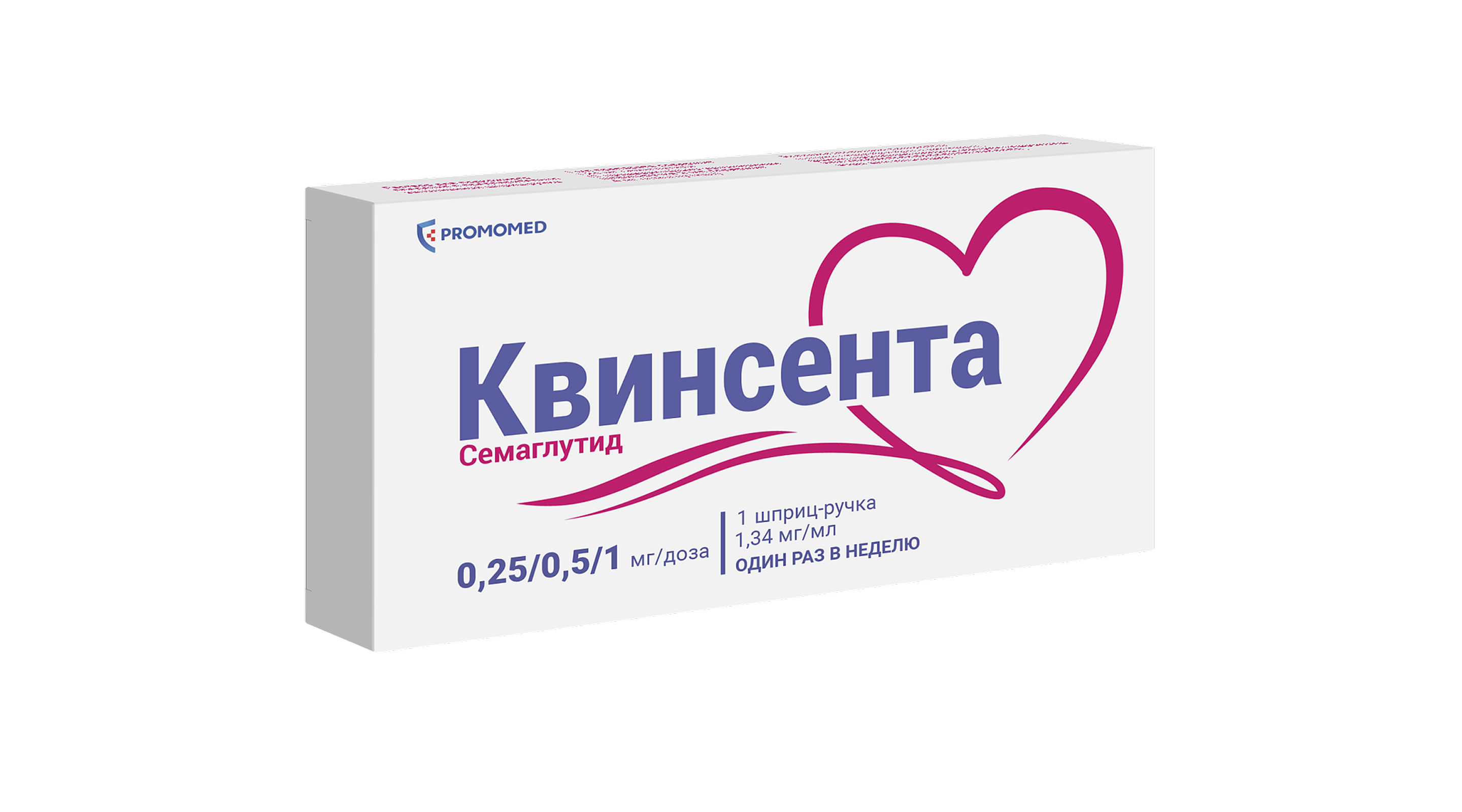

about the product
A clear, colorless or slightly brownish solution.
Drug website
kvinsenta.comOriginal product
This product is a fully original Promomed product
On every original product you will see our brand label

Specifications
Name
Quincenta®
Dosage form
Solution for subcutaneous administration
Nosological classification
Drugs for the treatment of diabetes mellitus
INN
Semaglutide
Dosages
0.25/0.5 mg/dose; 0.25/0.5/1 mg/dose
ATC code
A10BJ06
Active substance
Semaglutide - 1.34mg
Pharmacotherapeutic group
Endocrinological preparations
use
The drug Quincenta is used once a week at any time, regardless of food intake.
The drug of Quincent is injected subcutaneously into the abdomen, hip or shoulder. The injection site may change without dose adjustment. The drug Quincent should not be administered intravenously or intramuscularly.
If necessary, the day of weekly administration can be changed, provided that the time interval between two injections is at least 3 days (> 72 hours). After choosing a new day of administration, the drug should be continued once a week.
Help
Package leaflet
Semaglutide reduces fasting glucose concentration and postprandial glucose (PPG) concentration. Semaglutide improves the function of pancreatic beta cells. After intravenous glucose injection in patients with T2DM, semaglutide improved the first and second phases of the insulin response with a threefold and twofold increase, respectively, and increased the maximum secretory activity of pancreatic beta cells after an arginine stimulation test compared with placebo.
The drug Quincenta is indicated for use in adult patients with type 2 diabetes mellitus on the background of diet and exercise to improve glycemic control as:
- monotherapy;
- combination therapy with other oral hypoglycemic drugs (PGGP) – metformin, metformin and sulfonylurea derivatives, metformin and/or thiazolidinedione in patients who have not achieved adequate glycemic control during previous therapy;
- combination therapy with insulin in patients who have not achieved adequate glycemic control on therapy with semaglutide and metformin.
The drug Quincenta is indicated to reduce the risk of serious cardiovascular events* in patients with type 2 diabetes mellitus and high cardiovascular risk as an adjunct to standard treatment of cardiovascular diseases.
*Serious cardiovascular events include: death due to cardiovascular disease, non-fatal myocardial infarction, and non-fatal stroke.
Overdoses of up to 4 mg in a single dose and up to 4 mg per week have been reported during CI. The most common HP reported was nausea. All patients recovered without complications.
There is no specific antidote for an overdose of the drug Quincent. In case of overdose, appropriate symptomatic therapy is recommended. Given the long elimination period of the drug (approximately 1 week), an extended period of monitoring and treatment of overdose symptoms may be required.
The most frequently reported adverse reactions (HP) during CI were gastrointestinal disorders, including nausea, diarrhea, and vomiting. In general, these reactions were mild to moderate in severity and short-term.
For more information about all possible adverse reactions and the frequency of their occurrence, see the instructions in the leaflet.
- Hypersensitivity to semaglutide or any of the excipients of the drug
- History of medullary thyroid cancer, including family history
- Multiple endocrine neoplasia (MEN) type 2
- Type 1 diabetes mellitus (DM1)
- Diabetic ketoacidosis
The use of the drug Quincenta is contraindicated in the following groups of patients and in the following conditions / diseases due to the lack of data on efficacy and safety or limited experience of use:
- pregnancy and breastfeeding;
- under the age of 18;
- severe liver failure;
- end-stage renal failure (creatinine clearance <15 ml/min);
- chronic heart failure (CHF) of functional class IV (according to the NYHA (New York Heart Association) classification).
In vitro studies of semaglutide have shown a very low probability of inhibition or induction of cytochrome P450 (SUR) system enzymes and inhibition of drug transporters. Delayed gastric emptying when using semaglutide may affect the absorption of concomitant oral medications. Semaglutide should be used with caution in patients receiving oral medications that require rapid absorption into the gastrointestinal tract.
Paracetamol When evaluating the pharmacokinetics of paracetamol during a standardized meal test, it was found that semaglutide delays gastric emptying. With simultaneous use of semaglutide at a dose of 1 mg, AUC0-60 min and Cmax of paracetamol decreased by 27% and 23%, respectively. The total exposure to paracetamol (AUC0-5 h) did not change. When taking semaglutide and paracetamol at the same time, no dose adjustment of the latter is required.
Oral hormonal contraceptives
It is not assumed that semaglutide reduces the effectiveness of oral hormonal contraceptives. When combined oral hormonal contraceptive drug (0.03 mg ethinylestradiol/ 0.15 mg levonorgestrel) and semaglutide were used simultaneously, the latter had no clinically significant effect on the total exposure of ethinylestradiol and levonorgestrel. Exposure to ethinyl estradiol was not affected; there was a 20% increase in levonorgestrel exposure at steady state. The cmax has not changed for any of the components.
Atorvastatin
Semaglutide did not alter the systemic exposure of atorvastatin after administration of a single dose of atorvastatin (40 mg). The cmax of atorvastatin decreased by 38%. This change was considered to be clinically insignificant.
Digoxin
Semaglutide did not alter systemic exposure or Cmax of digoxin after administration of a single dose of digoxin (0.5 mg).
Metformin
Semaglutide did not alter systemic exposure or Cmax of metformin after administration of 500 mg metformin twice daily for 3.5 days.
Warfarin
Semaglutide did not alter the systemic exposure or Cmax of the R- and S-isomers of warfarin after administration of a single dose of warfarin (25 mg). Based on the definition of the international normalized ratio (INR), there were also no clinically significant changes in the pharmacodynamic effects of warfarin.
Incompatibility
Substances added to the Quincent preparation may cause degradation of semaglutide. The drug Quincenta should not be mixed with other medicines, including infusion solutions.
The holder of the registration certificate
JSC Biochemist, Russian Federation
15A Vasenko St., Saransk, 430030, Republic of Mordovia
Manufacturer
JSC Biochemist, Russian Federation
Address: 15A Vasenko St., Saransk, 430030, Republic of Mordovia
Phone: +7 (8342) 38 03 68
Email: biohimic@promomed.pro
Internet address: promomed.pro
The organization that accepts consumer claims
JSC Biochemist, Russian Federation
Address: 15A Vasenko St., Saransk, 430030, Republic of Mordovia
Phone number: 8 800 222 95 63; 8 800 777 86 04 ( around the clock)
Email: hot_line@promomed.pro
Store at a temperature of 2 to 8 degrees Celsius (in the refrigerator), but not near the freezer. Protect from light. Do not freeze. A syringe pen with the drug that is used or carried as a spare should be stored at a temperature of no more than 30 ° C or at a temperature of 2 to 8 ° C (in the refrigerator) for 6 weeks. Do not freeze. After use, cover the pen with a cap to protect it from light.
Semaglutide is recommended to be used with caution in patients with renal insufficiency and in patients with a history of pancreatitis.
Semaglutide has no or negligible effect on the ability to drive vehicles or operate machinery. Patients should be warned that they should take precautions to avoid the development of hypoglycemia while driving vehicles and when working with mechanisms, especially when using the drug Quincenta in combination with a sulfonylurea derivative or insulin.
our partners
Where to buy