
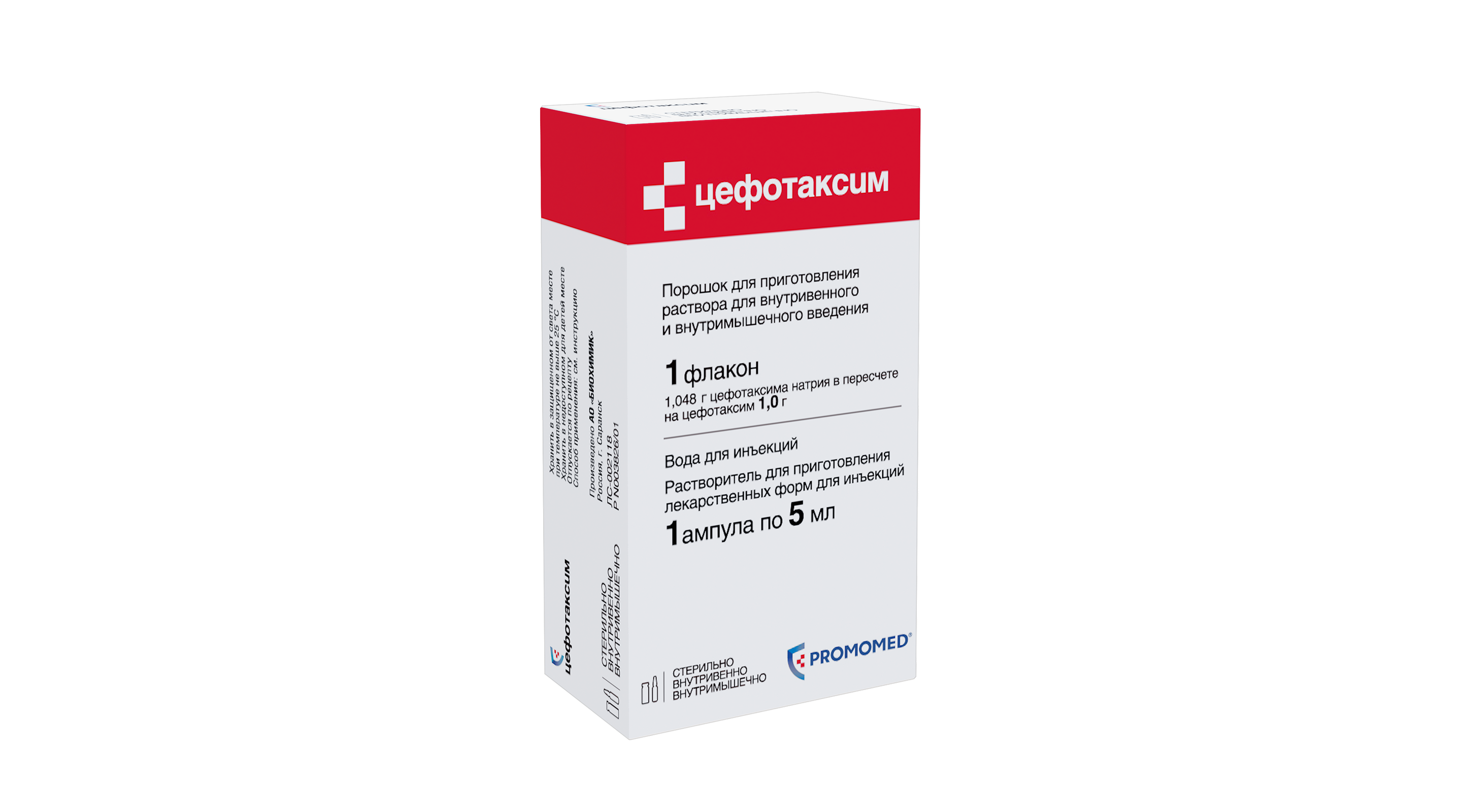

about the product
The powder is white to slightly yellow in color.
A semi-synthetic antibiotic of the cephalosporin group of the third generation, with a wide spectrum of action. It is prescribed for infections caused by microorganisms sensitive to it.
A semi-synthetic antibiotic of the cephalosporin group of the third generation, with a wide spectrum of action. It is prescribed for infections caused by microorganisms sensitive to it.
Specifications
Name
Cefotaxime
Dosage form
POWDER FOR SOLUTION PREPARATION FOR INTRAVENOUS AND INTRAMUSCULAR ADMINISTRATION
Nosological classification
Antibacterial drugs of systemic action
INN
Cefotaxime
Dosages
1 g
ATC code
J01DD01
Active substance
Cefotaxime sodium (in terms of active substance) – 1.0 g
Pharmacotherapeutic group
Antibacterial
use
Intramuscularly and intravenously.
The dose, method, and frequency of administration should be determined by the severity of the infection, the sensitivity of the pathogen, and the patient's condition. Treatment should be initiated before receiving the results of the sensitivity test.
Adults and children over 12 years of age and with a body weight of 50 kg or more with mild and moderate infections – 1 g every 12 hours. The dose may vary depending on the severity of the infection, the sensitivity of the pathogen, and the patient's condition. In severe infections, the dose can be increased to 12 g per day, divided into 3-4 injections. For infections caused by Pseudomonas spp., the daily dose should be more than 6 g.
For children under 12 years of age and weighing up to 50 kg, the usual dose is 100-150 mg / kg of body weight per day, divided into 2-4 injections. For very severe infections, the dose can be increased to 200 mg / kg of body weight per day.
For newborns, the dose is 50 mg / kg of body weight per day, divided into 2-4 injections. For severe infections, a dose of 150-200 mg / kg of body weight per day, divided into 2-4 injections.
With gonorrhea: 1 g once intramuscularly or intravenously.
To prevent infections before surgery (30 to 90 minutes before surgery) 1 g is administered intramuscularly or intravenously.
When performing a cesarean section, 1 g of the drug is injected intravenously at the time of applying clamps to the umbilical vein, then after 6-12 hours 1 g is re-injected intramuscularly or intravenously.
Patients with renal insufficiency
In cases where creatinine clearance is less than 10 ml / min, it is necessary to reduce the dose. After the initial single dose is administered, the daily dose should be halved without changing the frequency of administration, that is, instead of 1 g every 12 hours – 0.5 g every 12 hours, instead of 1 g every 8 hours – 0.5 g every 8 hours, instead of 2 g every 8 hours – 1 g every 8 hours, etc. It may be necessary further dose adjustment depending on the course of the infection and the general condition of the patient.
Patients on hemodialysis are prescribed 1-2 g per day, depending on the severity of the infection. On the day of hemodialysis, cefotaxime should be prescribed after the end of the hemodialysis session, since cefotaxime is removed during hemodialysis.
Patients undergoing peritoneal dialysis are prescribed 1-2 g per day, depending on the severity of the infection. Cefotaxime is not removed during peritoneal dialysis.
Rules for the preparation of solutions
For intravenous injection, water for injection is used as a solvent (1 g is diluted in 4 ml), with intravenous injection, the solution should be administered within 3 to 5 minutes. For intravenous infusion, 0.9% sodium chloride solution or 5% dextrose solution is used as a solvent (1-2 g is diluted in 40-100 ml of solvent). Ringer's lactate solution can also be used. The duration of the infusion is 20-60 minutes. For intramuscular injection, water for injection or 1% lidocaine solution is used (1 g is diluted in 4 ml of solvent)
.
Help
Package leaflet
A semi-synthetic antibiotic of the cephalosporin group of the third generation for parenteral use. Cefotaxime acts bactericidal due to disruption of bacterial wall synthesis. It is also resistant to the action of most β-lactamases.
Cefotaxime is intended for the treatment of infections caused by microorganisms,
- sensitive to the drug:
- respiratory tract infections;
- urinary tract infections;
- septicemia, bacteremia;
- endocarditis;
- intra-abdominal infections (including peritonitis);
- meningitis (except listeriosis) and other CNS infections;
- infections of the skin and soft tissues;
- infections of bones and joints;
There is a risk of developing reversible encephalopathy when using high doses of beta-lactam antibiotics, including cefotaxime, especially in case of overdose or impaired renal function. There is no specific antidote. Cefotaxime can be removed by hemodialysis and is not removed by peritoneal dialysis.
Infectious and parasitic diseases
Frequency unknown: superinfections.
As with other antibiotics, the use of cefotaxime, especially for a long time, can lead to excessive growth of insensitive microorganisms. The patient's condition should be monitored regularly. If superinfection develops during cefotaxime therapy, appropriate measures should be taken.
Disorders of the blood and lymphatic system
Rare: leukopenia, eosinophilia, thrombocytopenia.
The frequency is unknown: insufficiency of bone marrow hematopoiesis, pancytopenia, neutropenia, agranulocytosis, hemolytic anemia.
Disorders of the immune system
Infrequently: Yarish-Gerksheimer reaction. As with other antibiotics, when treating borreliosis, a Yarisch-Herxheimer reaction may develop during the first days of therapy. There are reports of one or more symptoms occurring after several weeks of treatment for borreliosis: skin rash, itching, fever, leukopenia, increased activity of "liver" enzymes, difficulty breathing, and joint discomfort. It should be borne in mind that to some extent, these manifestations are consistent with the symptoms of the underlying disease for which the patient is receiving treatment.
Frequency unknown: anaphylactic reactions, angioedema, bronchospasm, anaphylactic shock.
Disorders of the nervous system
Infrequently: seizures.
Frequency unknown: encephalopathy (which may be manifested by seizures, confusion, impaired motor activity), headache, dizziness.
Cardiac disorders
Frequency unknown: arrhythmias (due to rapid bolus injection through a central venous catheter).
Disorders of the gastrointestinal tract
Infrequently: diarrhea.
Frequency unknown: nausea, vomiting, abdominal pain, pseudomembranous colitis.
Hypersensitivity to cefotaxime and other cephalosporins.
For forms containing lidocaine as a solvent:
- hypersensitivity to lidocaine or other local anesthetic of the amide type;
- intracardiac blockages without an established pacemaker;
- severe heart failure;
- intravenous administration;
- children under 2.5 years of age (intramuscular injection).
Probenecid delays excretion and increases the concentration of cephalosporins in blood plasma.
As with other cephalosporins, cefotaxime may enhance the nephrotoxic effect of drugs with nephrotoxic effects (such as furosemide, aminoglycosides).
Compatibility notes
cefotaxime should not be mixed with other antibiotics (including aminoglycosides), either in one syringe or in one infusion solution.
The following solutions can be used for infusions (concentration of cefotaxime 1 g / 250 ml): water for injection, 0.9% sodium chloride solution, 5% dextrose solution, Ringer's lactate solution, Ionosteril.
The owner of the registration certificate:
PROMOMED RUS LLC, Russia. 2/2 Pochtovaya str., building 1, room I, Moscow, 105005. 2.
Manufacturer:
JSC Biochemist, Russia. Legal address: 15A Vasenko St., Saransk, 430030, Republic of Mordovia.
The address of the place of production: 430030, Republic of Mordovia, Saransk, Vasenko str., 15A.
Phone: (8342) 38-03-68
E-mail: biohimic@biohimic.ru, www.biohimik.ru
Name, address and telephone number of the authorized organization for contacts (sending claims and complaints):
PROMOMED RUS LLC, Russia.
13 Mira Ave., building 1, Moscow, 129090.
Tel.: 8-800-777-86-04 (free of charge), 8-495-640-25-28.
Email address: reception@promo-med.ru
Pregnancy Cefotaxime penetrates the placental barrier. Animal studies have not revealed teratogenic or fetotoxic effects of the drug. However, the safety of cefotaxime during pregnancy in humans has not been established, so the drug should not be used during pregnancy.
In a place protected from light at a temperature not exceeding 25 ° C. Keep out of reach of children.
2 years. Do not use after the expiration date.
our partners
Where to buy