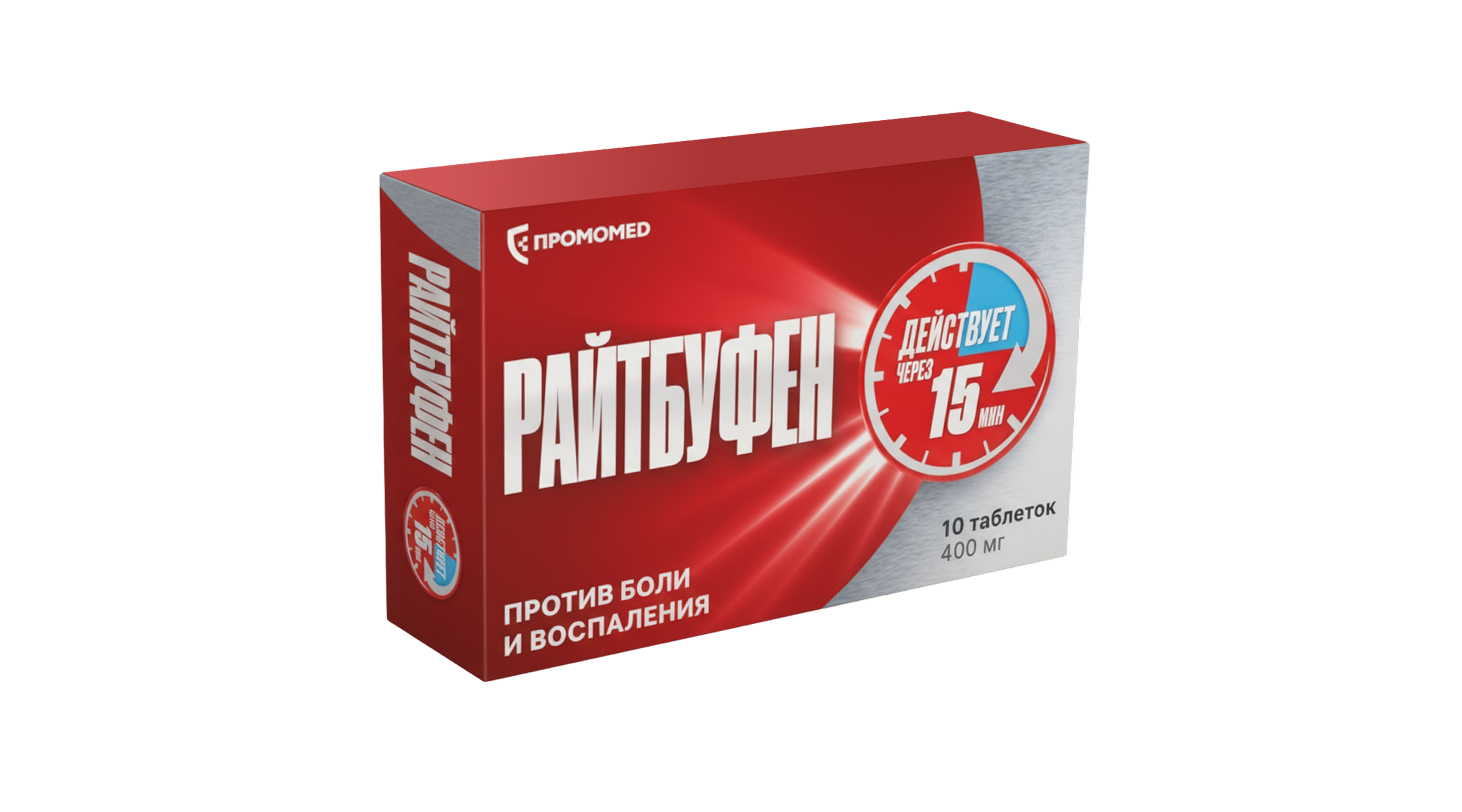

about the product
REITBUFEN, 200 mg, film-coated tablets of white or almost white color, oval, biconvex. In the cross-section, the core is white or almost white.
REITBUFEN, 300 mg, film-coated tablets of white or almost white color, oval, biconvex with a risk on one side. In the cross-section, the core is white or almost white. The fault line (risk) is not designed to break the tablet.
REITBUFEN, 400 mg, film-coated tablets of white or almost white color, oval, biconvex. In the cross-section, the core is white or almost white.
Specifications
Name
Reitbufen
Dosage form
Film-coated tablets
Nosological classification
Anti-inflammatory and antirheumatic drugs
INN
Dexibuprofen
Dosages
200 mg; 300 mg; 400 mg
ATC code
M01AE14
Active substance
dexibuprofen
Pharmacotherapeutic group
Neurological drugs
use
Always take the drug in full accordance with the leaflet or with the recommendations of your doctor or pharmacy employee. If in doubt, consult your doctor or a pharmacy employee.
Recommended dose
The maximum single dose of dexibuprofen is 400 mg (1 tablet of 400 mg or 2 tablets of 200 mg each).
The maximum daily dose of dexibuprofen is 1200 mg.
Film-coated tablets containing 200 mg, 300 mg and 400 mg of dexibuprofen are available for individual dosage regimens.
Primary dysmenorrhea
The recommended daily dose is 600-900 mg of dexibuprofen, divided into 3 doses (1 tablet 200 mg or 1 tablet 300 mg 3 times a day).
The maximum single dose is 300 mg (1 tablet of 300 mg), the maximum daily dose is 900 mg (1 tablet of 300 mg 3 times a day).
Symptomatic treatment of pain and inflammation associated with osteoarthritis
The recommended daily dose is 600-900 mg of dexibuprofen, divided into 3 doses.
The dose can be increased to the maximum (1200 mg of dexibuprofen per day – 1 tablet of 400 mg 3 times a day or 2 tablets of 200 mg 3 times a day) in patients with severe pain syndrome.
Symptomatic treatment of mild to moderate pain, including headache, migraine, toothache, muscle pain, and joint pain
The recommended dose is 200 mg of dexibuprofen 3 times a day.
If there is a clear need to increase the dose of the drug in patients with acute pain conditions (for example, during surgical tooth extraction), the dose can be temporarily increased to the maximum (1200 mg of dexibuprofen per day – 1 tablet of 400 mg 3 times a day or 2 tablets of 200 mg 3 times a day).
Route and (or) method of administration
For oral administration.
Tablets can be taken regardless of food intake. As a rule, nonsteroidal anti-inflammatory drugs (NSAIDs) should preferably be taken with meals to reduce gastrointestinal irritation, especially with prolonged use. However, when using tablets during meals or immediately after meals, the effect of the drug may appear a little later.
If you have gastrointestinal diseases, it is recommended to take this medication during meals.
Help
Package leaflet
Dexibuprofen is a specially obtained right–rotating isomer of the substance ibuprofen (isomers are substances having the same composition, but different spatial arrangement of atoms and, as a result, different properties). Only the right-rotating isomer of ibuprofen has the ability to inhibit the activity of cyclooxygenase (an enzyme involved in the development of inflammation). This leads to a more pronounced reduction in the symptoms of pain and inflammation. The structural features of dexibuprofen allow it to dissolve faster in the acidic environment of the stomach, penetrate through membrane barriers and bind better to receptors, which leads to an accelerated analgesic effect and a longer duration of action compared to the racemic ibuprofen mixture (a mixture of right-rotating and left-rotating isomers of ibuprofen).
Dexibuprofen has analgesic, anti-inflammatory and antipyretic effects.
The drug REITBUFEN is indicated for use in adults over the age of 18 for symptomatic treatment.:
- mild to moderate pain, including headache, migraine, toothache, muscle pain, and joint pain;
- painful sensations during menstruation (primary dysmenorrhea);
- pain and inflammation associated with osteoarthritis (a chronic joint disease in which there is a gradual destruction of cartilage, changes in the underlying bone, inflammation of the synovial membrane, muscles, ligaments of joints);
Most cases of dexibuprofen overdose are asymptomatic. As a rule, overdose symptoms appear within 4 hours. The most common symptoms are mild overdose, including abdominal pain, nausea, vomiting, lethargy, drowsiness, headache, frequent involuntary eye twitching (nystagmus), tinnitus, and movement coordination disorder (ataxia).
Symptoms of moderate to severe overdose are rare; they include gastrointestinal bleeding, a decrease in blood pressure below normal (hypotension), a decrease in temperature below normal (hypothermia), a violation of the acid-base balance of the body (metabolic acidosis), seizures, impaired kidney function, coma, severe respiratory failure in adults (respiratory distress syndrome in adults) and transient episodes of respiratory arrest (apnea) (in very young children after ingestion of a large amount of the drug).
Like all medications, the drug REITBUFEN can cause undesirable reactions, but they do not occur in everyone. The likelihood of adverse reactions from the gastrointestinal tract is reduced if dexibuprofen is taken in low doses or for a short time.
Stop taking REITBUFEN and seek immediate medical attention if any of the following signs of serious adverse reactions occur:
• gastrointestinal ulcers, sometimes with bleeding and perforation (may occur frequently − in no more than 1 person out of 10), the signs of which may be black, tar-like stools (melena), vomiting with blood, pain in the upper abdomen, nausea, weakness, dizziness, tinnitus;
• bullous reactions, including Stevens-Johnson syndrome and acute toxic epidermal necrolysis (Lyell's syndrome); erythema multiforme; drug-induced reaction with eosinophilia and systemic symptoms (DRESS syndrome); acute generalized exanthematous pustulosis (OGEP) (may occur very rarely – no more than 1 in 10,000 people or with unknown frequency (based on available data, it is impossible to estimate) – severe skin reactions with high body temperature, pain and swelling in the throat, severe itching, peeling of the skin, formation of blisters (blisters) on the skin and mucous membranes of the lips, eyes, mouth, nose, genitals, accompanied by bleeding;
• angioedema (may occur very rarely – no more than 1 in 10,000 people) – rapid swelling of the skin (lips, eyelids), subcutaneous tissue, mucous membranes or submucosa (tongue, tonsils, soft palate);
• severe allergic reactions (may occur very rarely – in no more than 1 in 10,000 people), including swelling of the face, swelling of the tongue, and the inner part of the larynx with narrowing of the airways, difficulty breathing, tachycardia, and decreased blood pressure, the development of potentially life-threatening shock, and exacerbation of bronchial asthma;
• aseptic meningitis (can occur very rarely – in no more than 1 person out of 10,000), the signs of which are severe headache, high body temperature, neck stiffness or intolerance to bright light;
• myocardial infarction (may occur very rarely – in no more than 1 person out of 10,000), possible signs of which are burning chest pain with spread to the left shoulder blade, left arm, shortness of breath, weakness, sweating);
• a sharp decrease in the number of cells responsible for immunity in the blood (agranulocytosis, determined by the results of a blood test) (it can occur very rarely – no more than 1 person out of 10,000). Early signs include fever, sore throat, superficial mouth ulcers, flu-like symptoms, severe exhaustion, nosebleeds, and skin hemorrhages. In such cases, it is necessary to immediately stop treatment, avoid self-treatment with analgesics or antipyretics, and consult a doctor.
(For more information about all possible adverse reactions, see the leaflet)
Do not take the drug REITBUFEN if:
• You are allergic to dexibuprofen, NSAIDs, or any other components of the drug listed in section 6 of the leaflet.;
• Have you ever had the following allergic reactions after taking acetylsalicylic acid (aspirin) or other NSAIDs: bronchospasm, bronchial asthma, runny nose (rhinitis), nasal polyps, angioedema or urticaria;
• You have had gastrointestinal bleeding or violations of the integrity of the gastrointestinal wall (gastrointestinal perforation) associated with previous NSAID therapy;
• you have hematopoiesis disorders, the cause of which is unknown;
• you have erosive and ulcerative diseases of the gastrointestinal tract (including peptic ulcer of the stomach and duodenum, chronic inflammatory disease of the gastrointestinal tract, characterized by damage to the intestinal wall with the development of complications (Crohn's disease), inflammatory disease of the colon, accompanied by the formation of ulcers on the mucous membrane (ulcerative colitis)), existing or recurrent peptic ulcer, current or previous bleeding (two or more separate episodes of confirmed ulcer or bleeding);
• You have been diagnosed with a brain hemorrhage or other active bleeding;
• You have an increased tendency to bleeding (hemorrhagic diathesis) and other blood clotting disorders;
• You have severe liver failure;
• You have severe kidney failure;
• You have severe heart failure;
• You have severe dehydration (for example, due to vomiting, frequent loose stools (diarrhea), and insufficient fluid intake);
• You are pregnant (more than 20 weeks old).
Tell your doctor that you are taking, have recently taken, or may start taking any other medications (For more information about the entire list of medications, see the instructions in the leaflet)
The holder of the registration certificate
JSC Biochemist, Russian Federation
15A Vasenko St., Saransk, 430030, Republic of Mordovia
Manufacturer
JSC Biochemist, Russian Federation
Address: 15A Vasenko St., Saransk, 430030, Republic of Mordovia
Phone: +7 (8342) 38 03 68
Email: biohimic@promomed.pro
Internet address: promomed.pro
The organization that accepts consumer claims
JSC Biochemist, Russian Federation
Address: 15A Vasenko St., Saransk, 430030, Republic of Mordovia
Phone number: 8 800 222 95 63; 8 800 777 86 04 ( around the clock)
Email: hot_line@promomed.pro
Keep the drug out of the reach of the child so that the child cannot see it. Do not take the drug after the expiration date (shelf life) indicated on the carton after "Good before". The expiration date is the last day of the given month. Store at a temperature not exceeding 25 ° C. Store in the original packaging (pack) to protect from light.
Adverse reactions such as dizziness, fatigue, drowsiness, and visual disturbances may occur while taking the drug REITBUFEN. If you experience the above adverse reactions, refrain from driving vehicles and working with mechanisms. No special precautions are required for single or short-term use of the drug REITBUFEN.
our partners
Where to buy