
about the product
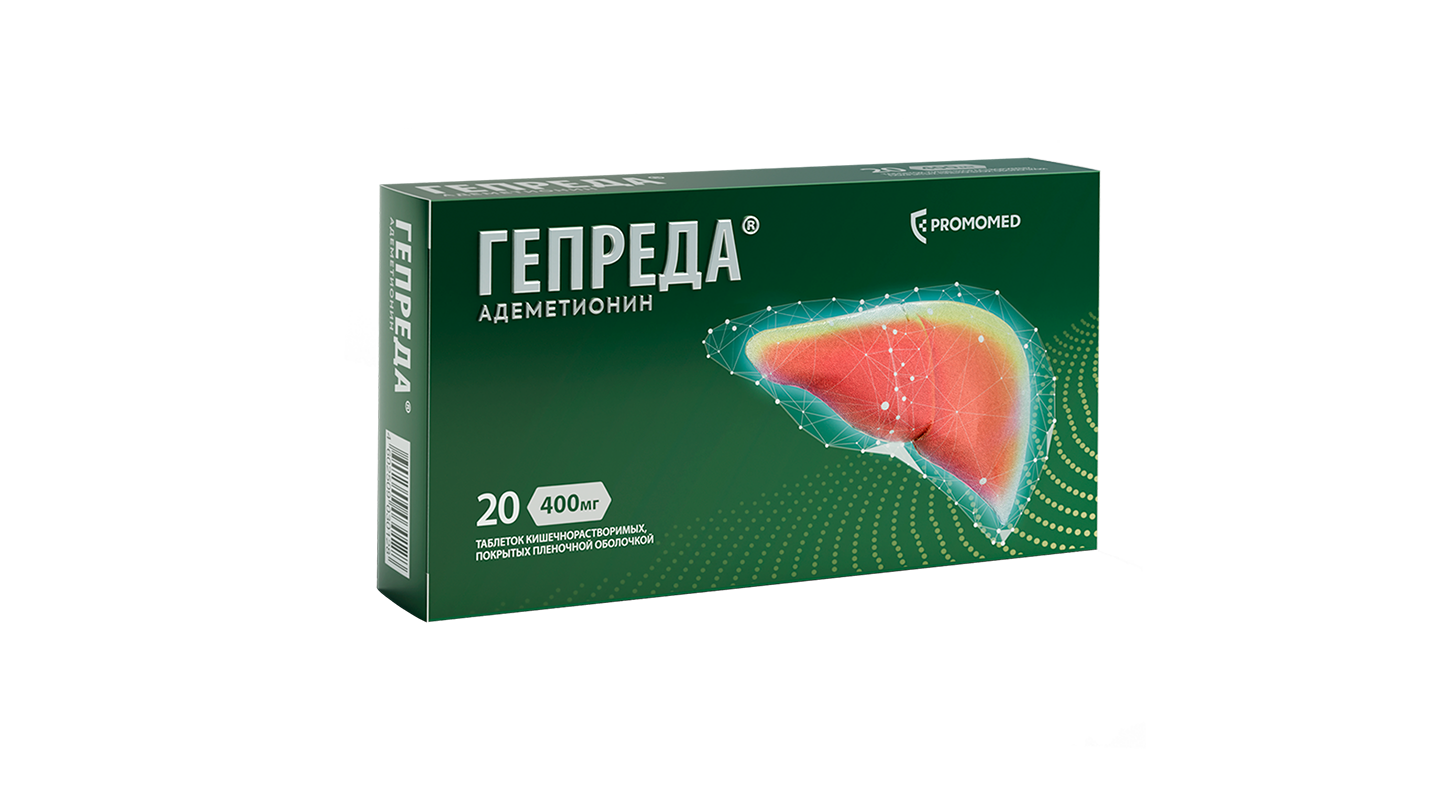
The tablets are oval, biconvex, and yellow film-coated. In the cross-section, the core is white to almost white in color.
Original product
This product is a fully original Promomed product
On every original product you will see our brand label

Specifications
Name
Gepreda®
Dosage form
Intestinal-soluble film-coated tablets
Nosological classification
Other drugs for the treatment of diseases of the gastrointestinal tract and metabolic disorders
INN
Ademethionine
Dosages
400 mg
ATC code
A16AA02
Active substance
Ademethionine 1,4-butaneisulfonate – 760 mg (in terms of ademethionine – 400 mg);
Pharmacotherapeutic group
General therapy drugs
use
Inside. Tablets should be taken whole without chewing, preferably in the morning between meals.
GEPREDA® tablets should be removed from the blister immediately before ingestion.
The recommended dose is 10-25 mg of ademethionine per 1 kg of body weight per day.
Usually, the daily dose is 1-2 tablets per day (from 400-800 mg of ademethionine per day) and can be increased to 4 tablets per day (up to 1600 mg of ademethionine per day). The effect usually appears after 7-14 days of treatment and persists with further use of the drug.
If there is no positive effect from the drug therapy carried out within 2 weeks or the condition worsens, you should consult a doctor.
Elderly patients
Clinical experience with ademetionine has not revealed any differences in its effectiveness in elderly and younger patients. However, given the high likelihood of liver, kidney, or heart dysfunction, other concomitant pathology, or concomitant therapy with other medications, the dose of GEPREDA® should be selected with caution in elderly patients, starting with the lower limit of the dose range.
Kidney failure
There are limited clinical data on the use of ademetionine in patients with renal insufficiency, and therefore caution is recommended when using GEPREDA® in such patients.
Liver failure
The pharmacokinetic parameters of ademetionine are similar in healthy volunteers and in patients with chronic liver diseases.
Children and teenagers under 18 years of age
The use of GEPREDA® in children and adolescents under 18 years of age is contraindicated (efficacy and safety have not been established).
Help
Package leaflet
Ademetionine belongs to the group of hepatoprotectors. It has a choleretic effect, has detoxifying, regenerating, antioxidant, antifibrosion and neuroprotective properties.
Ademethionine (S-adenosyl-L-methionine) is a naturally occurring amino acid that is present in virtually all tissues and body fluids. The highest concentration of ademethionine was found in the liver and brain. Ademethionine is a derivative of the sulfur–containing amino acid methionine. It plays a key role in the metabolic processes of the body, participates in important biochemical reactions. Participates in the synthesis of phospholipids of cell membranes, neurotransmitters, nucleic acids, proteins, hormones, etc.
Ademetionine is a precursor of cysteine, taurine, glutathione (providing the redox mechanism of cellular detoxification), coenzyme A (involved in the biochemical reactions of the tricarboxylic acid cycle and replenishes the energy potential of the cell).
Increases the content of glutamine in the liver, cysteine and taurine in plasma; reduces the content of methionine in serum, normalizing metabolic reactions in the liver. It is indirectly involved in stimulating the regeneration and proliferation of liver cells, which reduces the risk of fibrosis.
Ademetionine normalizes the synthesis of endogenous phosphatidylcholine in hepatocytes, which increases the fluidity and polarization of membranes. This improves the function of bile acid transport systems associated with hepatocyte membranes and promotes the passage of bile acids into the biliary tract. It is effective in the intracellular variant of cholestasis (violation
synthesis and flow of bile). Ademetionine reduces the toxicity of bile acids in liver cells. In patients with diffuse liver diseases (cirrhosis, hepatitis), ademetionine reduces the severity of skin itching and improves blood biochemical parameters, including the concentration of direct bilirubin, activity of alkaline phosphatase, aminotransferases, etc.
The choleretic and hepatoprotective effect persists for up to 3 months after discontinuation of treatment. Efficacy has been shown in hepatopathies caused by various hepatotoxic drugs. A number of studies have confirmed the effectiveness of ademetionine in the treatment of fatigue in patients with chronic liver diseases.
- Adjunctive therapy for established chronic liver diseases, to improve and maintain its functions
- Increased fatigue with established chronic liver diseases
Overdose with GEPREDA is unlikely.
In case of overdose with GEPREDA®, you should immediately consult a doctor.
Treatment: symptomatic.
Among the most common adverse reactions identified in clinical trials involving more than 2,000 patients were headache, nausea, and diarrhea.
The following are data on adverse reactions observed during clinical trials (n = 1922) and in the post-marketing follow-up period ("spontaneous" reports).
Adverse reactions are distributed by systemic organ classes and frequency of occurrence: very common (≥ 1/10); common (≥ 1/100, but <1/10); infrequent (≥ 1/1000, but <1/100); rare (≥ 1/10000, but <1/1000); very rare (<1/10000); frequency unknown (it is impossible to estimate based on the available data).
|
The organ system |
Frequency |
Undesirable effects |
|
Infections and infestations |
Infrequently |
Urinary tract infections |
|
Disorders of the immune system |
Infrequently |
Hypersensitivity reactions Anaphylactoid or anaphylactic reactions (including redness of the skin, shortness of breath, bronchospasm, back pain, chest discomfort, changes in blood pressure (decrease, increase) or pulse rate (increase, decrease)) |
|
Mental disorders |
Often |
Anxiety Insomnia |
|
Infrequently |
Agitation (strong emotional arousal accompanied by motor restlessness) Confusion of consciousness |
|
|
Disorders of the nervous system |
Often |
Headache |
|
Infrequently |
Dizziness Paresthesia Dysgeusia (taste disorders characterized by loss of taste or perversion of taste perceptions) |
|
|
Vascular disorders |
Infrequently |
"Tides" Reduction of blood pressure Phlebitis |
|
Respiratory, thoracic, and mediastinal disorders |
Infrequently |
Laryngeal edema |
|
Gastrointestinal disorders |
Often |
Abdominal pain Diarrhea Nausea |
|
Infrequently |
Dry mouth Dyspepsia Flatulence Gastrointestinal pain Gastrointestinal bleeding Gastrointestinal disorders |
|
|
Rarely |
Vomiting Esophagitis Bloating of the abdomen |
|
|
Disorders of the skin and subcutaneous tissues |
Often |
Skin itching |
|
Infrequently |
Increased sweating Angioedema Skin allergic reactions (including rash, pruritus, urticaria, erythema) |
- Genetic disorders affecting the methionine cycle and/or causing homocystinuria and/or hyperhomocysteinemia (cystathionine beta synthase deficiency, impaired vitamin B12 metabolism)
- Hypersensitivity to ademetionine and/or to any of the excipients in the preparation
- Under 18 years of age (due to the lack of data on the efficacy and safety of ademethionine in this age population)
- Bipolar disorders
With caution
− Concomitant administration with selective serotonin reuptake inhibitors (SSRIs), tricyclic antidepressants (such as clomipramine), as well as medicinal products and herbal preparations containing tryptophan (see section
"Interaction with other medicinal products")
− Old age
− Kidney failure
There have been no known interactions with other drugs. If you are using the following or other medications (including over-the-counter medications), consult your doctor before using GEPREDA®. There is a report of excess serotonin syndrome in a patient taking ademetionine and clomipramine. It is believed that such an interaction is possible, and ademetionine should be used with caution together with selective serotonin reuptake inhibitors, tricyclic antidepressants (such as clomipramine), as well as drugs containing tryptophan (including those of plant origin).
The holder of the registration certificate
PROMOMED RUS LLC, Russian Federation
Address: 13 Mira Avenue, building 1, office 13, Moscow, 129090
Manufacturer
JSC Biochemist, Russian Federation
Legal address: 430030, Republic of Mordovia, Saransk, Vasenko St.,
D. 15A
The address of the place of production: 430030, Republic of Mordovia, Saransk,
Vasenko St., 15A
Phone: +7 (8342) 38-03-68
Email: biohimic@promomed.pro
Internet address: promomed.pro
The organization that accepts consumer claims
PROMOMED RUS LLC, Russian Federation
Address: 13 Mira Avenue, building 1, office 13, Moscow, 129090
Phone number: 8 800 222 95 63; 8 800 777 86 04 ( around the clock)
Email: hot_line@promomed.pro
Before using GEPREDA®, if you are pregnant, or assume that you could be pregnant, or are planning pregnancy, you should consult your doctor. During breastfeeding, consult your doctor before using GEPREDA®.
The use of GEPREDA® during pregnancy and lactation is not recommended without medical supervision.
Dizziness and a decrease in blood pressure may occur when using GEPREDA®. If these adverse reactions occur, you should refrain from driving vehicles and mechanisms until they disappear.
Do not store at temperatures above 25 °C. Store in the original packaging (pack) to protect from light.
Keep out of reach of children.
3 years old
our partners
Where to buy