
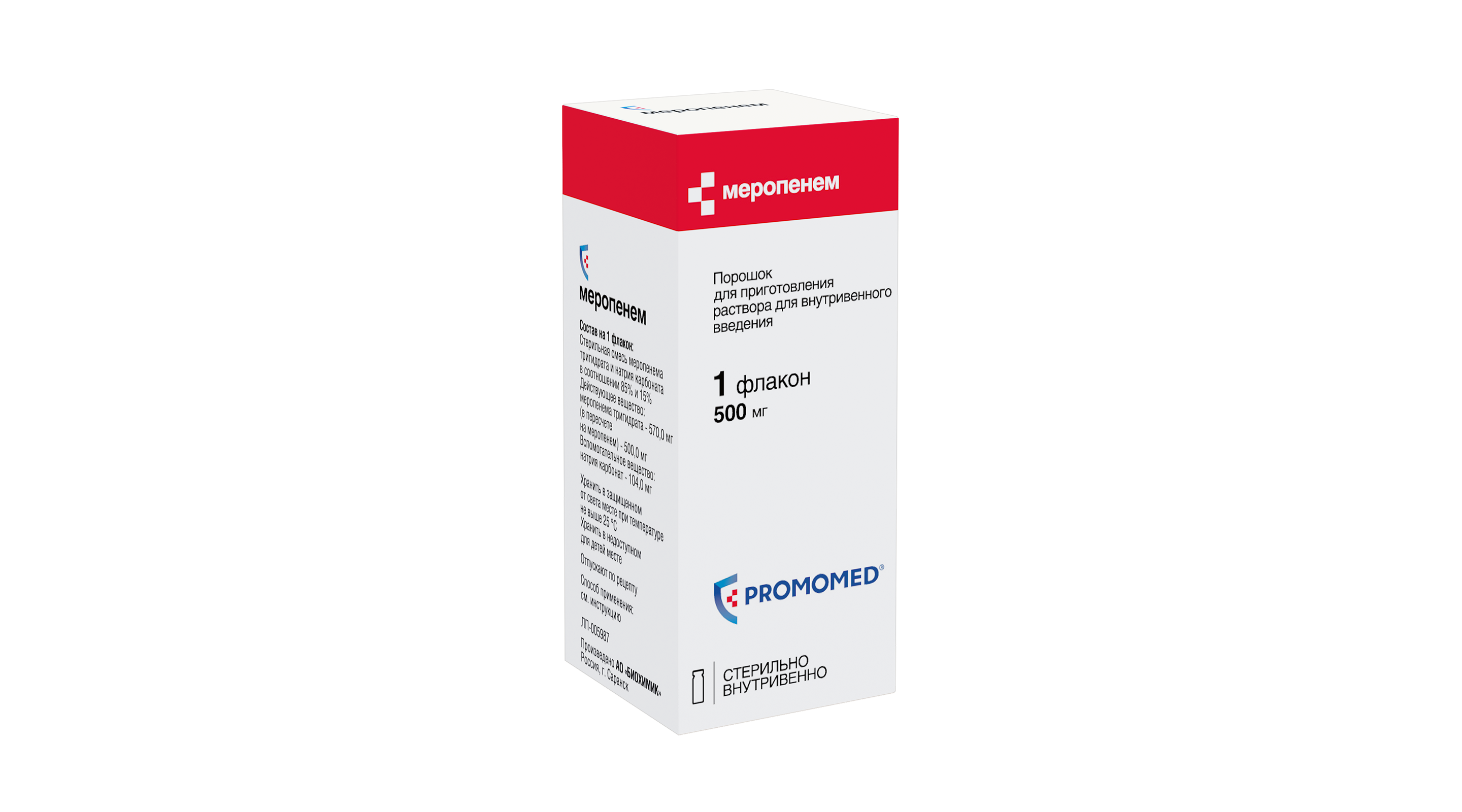

about the product
White or white powder with a yellowish tinge.Reconstituted solution: a clear solution of light yellow or greenish-yellow color.
A synthetic antibiotic from the carbapenem group. It is used to treat infections caused by one or more pathogens sensitive to the drug. It has a bactericidal effect
Specifications
Name
MEROPENEM
Dosage form
POWDER FOR PREPARATION OF SOLUTION FOR INTRAVENOUS ADMINISTRATION
Nosological classification
Antibacterial drugs of systemic action
INN
MEROPENEM
Dosages
1000 mg
ATC code
J01DH02
Active substance
A sterile mixture of meropenem trihydrate
and sodium carbonate in the ratio of 85 % and 15 %
per 500 and 1000 mg, respectively
Pharmacotherapeutic group
Antibacterial
use
Adults
The dose and duration of therapy should be adjusted depending on the type and severity of the infection and the patient's condition. The following daily doses are recommended: 500 mg intravenously every 8 hours in the treatment of pneumonia, urinary tract infections, gynecological infections such as endometritis, skin infections and skin structures; 1000 mg intravenously every 8 hours in the treatment of nosocomial pneumonia, peritonitis, suspected bacterial infection in patients with symptoms of neutropenia, as well as septicemia. In the treatment of meningitis, the recommended dose is 2000 mg every 8 hours. In the treatment of certain infections, in particular those caused by less sensitive pathogens (such as Enterobacteriaceae, Pseudomonas aeruginosa, Acinetobacter spp.), or very severe infections, the recommended dose is up to 2000 mg every 8 hours. The safety of taking a 2000 mg dose in the form of a bolus injection has not been sufficiently studied.
Children
For children aged 3 months to 12 years, the recommended dose for intravenous administration is 10-20 mg /kg every 8 hours, depending on the type and severity of infection, the sensitivity of the pathogen and the patient's condition.
Adult doses should be used in children weighing more than 50 kg.
For meningitis, the recommended dose is 40 mg/kg every 8 hours.
In the treatment of certain infections, in particular those caused by less sensitive pathogens (such as Enterobacteriaceae, Pseudomonas aeruginosa, Acinetobacter spp.), or very severe infections, the recommended dose is up to 40 mg /kg every 8 hours.
The safety of taking a dose of 40 mg/kg in the form of a bolus injection has not been sufficiently studied.
There is no experience of using the drug in children with impaired liver and kidney function.
The method of introduction
Meropenem can be administered as an intravenous bolus injection for at least 5 minutes, or as an intravenous infusion for 15-30 minutes; appropriate infusion fluids should be used for dilution.
The possibility of using meropenem in the extended infusion mode (up to 3 hours) is based on pharmacokinetic and pharmacodynamic parameters. To date, clinical and safety data supporting this regimen are limited.
To prepare a solution for intravenous bolus injections, meropenem should be dissolved with water for injection (5 ml per
250 mg of meropenem), with a solution concentration of 50 mg/ml.
To prepare a solution for intravenous infusion, meropenem should be dissolved with 0.9% sodium chloride solution for infusion or 5% dextrose (glucose) solution for infusion, while the concentration of the solution should be from 1 to 20 mg / ml.
The meropenem solution should not be frozen.
The prepared solution is recommended to be administered immediately after preparation (from a microbiological point of view), if the conditions of preparation of the solution do not exclude the possibility of microbiological contamination.
Help
Package leaflet
Meropenem is an antibiotic of the carbapenem class, intended for parenteral use, relatively resistant to human dehydropeptidase-1 (DHP-1), and does not require additional administration of a DHP-1 inhibitor. Meropenem has a bactericidal effect by affecting the synthesis of the bacterial cell wall. The high bactericidal activity of meropenem against a wide range of aerobic and anaerobic bacteria is explained by meropenem's high ability to penetrate the bacterial cell wall, high stability to most β-lactamases, and significant affinity to various penicillin-binding proteins (PSBs). Minimum bactericidal concentrations (MBCS) are usually the same as minimum inhibitory concentrations (MICS). For 76% of the bacterial species tested, the MBQ/MIC ratio was 2 or less.
Meropenem is indicated for the treatment of the following infectious and inflammatory diseases in children (older than 3 months) and adults caused by one or more pathogens sensitive to meropenem:
- pneumonia, including nosocomial pneumonia;
- urinary tract infections;
- infections of the abdominal cavity;
- infectious and inflammatory diseases of the pelvic organs, such as endometritis;
- infections of the skin and its structures;
- meningitis;
- septicemia.
Empirical therapy of adult patients with suspected infection with symptoms of febrile neutropenia in monotherapy or in combination with antiviral or antifungal drugs.
The effectiveness of meropenem has been proven both in monotherapy and in combination with other antimicrobial agents in the treatment of polymicrobial infections.The use of meropenem intravenously was effective for the treatment of cystic fibrosis and chronic lower respiratory tract infections both in monotherapy and in combination with other antibacterial drugs. Microbial eradication has not always been confirmed.
Relative overdose is possible in patients with renal insufficiency if no dose adjustment has been performed (see section "Dosage and administration").
Symptoms: increased dose-dependent side effects; manifest mainly in the form of disorders of the central nervous system (confusion, dizziness, impaired consciousness and seizures of the type of epileptic seizures).
Treatment: symptomatic. With normal renal function, the drug is rapidly excreted by the kidneys; with renal insufficiency, meropenem and its metabolite are eliminated from the body by hemodialysis.
In general, meropenem is well tolerated. In rare cases, side effects led to the cancellation of therapy. Serious adverse reactions are rare.
Hypersensitivity to meropenem, to excipients or other drugs of the carbapenem group in the anamnesis. Severe hypersensitivity (anaphylactic reactions, severe skin reactions) to any antibacterial agent with a beta-lactam structure (i.e. to penicillins or cephalosporins). Children under 3 months of age.
Probenecid competes with meropenem for active tubular secretion and, thus, inhibits the renal excretion of meropenem, causing an increase in its half-life and plasma concentration. Since the effectiveness and duration of action of meropenem administered without probenecid are adequate, their combined administration is not recommended.
The possible effect of meropenem on the degree of binding of other drugs to plasma proteins or on their metabolism has not been studied. Given the low binding of meropenem to plasma proteins (about 2%), interactions with other drugs based on the mechanism of displacement from binding to plasma proteins are not expected.
The owner of the registration certificate:
PROMOMED RUS LLC, Russia. 2/2 Pochtovaya str., building 1, room I, Moscow, 105005. 2.
Manufacturer: JSC Biochemist, Russia. Legal address: 15A Vasenko St., Saransk, 430030, Republic of Mordovia.
Production site address: 15A Vasenko St., Saransk, 430030, Republic of Mordovia. Tel.: (8342) 38-03-68 E-mail: biohimic@biohimic.ruwww.biohimic.ru
The organization that accepts consumer claims:
PROMOMED RUS LLC, Russia.
13 Mira Ave., building 1, Moscow, 129090.
Tel.: 8-800-777-86-04 (free of charge), 8-495-640-25-28.
E-mail: reception@promo-med.ru
In a place protected from light at a temperature not exceeding 25 ° C. Keep out of reach of children.
4 years old. Do not use after the expiration date.
our partners
Where to buy