
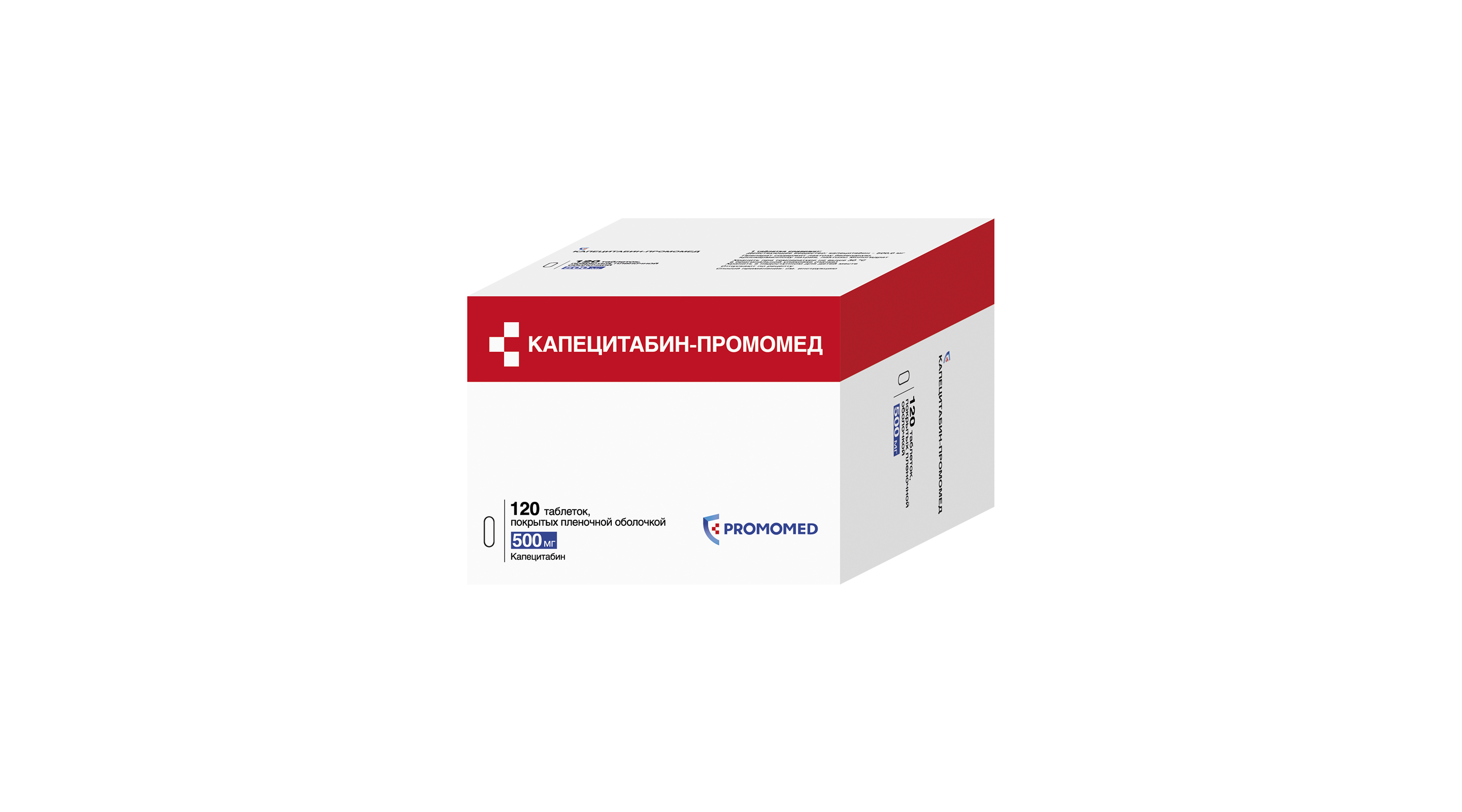

about the product
The dosage is 150 mg: Tablets are oval, biconvex, film-coated, light orange in color. In the cross-section, the core is white to almost white in color.
Dosage 500 mg: Tablets are oval, biconvex, film-coated in orange color. In the cross-section, the core is white to almost white in color.
Specifications
Name
Capecitabine-Promomed
Dosage form
Film-coated tablets
Nosological classification
Antitumor drugs
INN
Capecitabine
Dosages
150 mg; 500 mg
ATC code
L01BC06
Active substance
Capecitabine
Pharmacotherapeutic group
Cancer drugs
use
Inside completely, washed down with water, no later than 30 minutes after eating. Tablets should not be crushed or broken (see section "Side effects").
If the patient cannot swallow the tablet whole, then crushing or breaking the tablet should be carried out by a medical specialist.
Standard dosage regimen
Monotherapy
Colorectal cancer, colon cancer, and breast cancer
1250 mg / m2 2 times a day – morning and evening (total daily dose 2500 mg / m2) for 14 days followed by a 7-day break.
Combination therapy
Breast cancer
1250 mg / m2 2 times a day for 14 days, followed by a 7-day break, in combination with docetaxel at a dose of 75 mg / m2 once every 3 weeks as an intravenous infusion for 1 hour.
Premedication is performed before the administration of docetaxel in accordance with the instructions for its use.
Colorectal cancer, colon cancer, and stomach cancer
As part of combination therapy (with the exception of therapy in combination with irinotecan), the dose of Capecitabine-Promomed is 800-1000 mg / m2 2 times a day for 14 days followed by a 7-day break or 625 mg / m2 2 times a day with a continuous regimen.
As part of combination therapy with irinotecan (XELIRI regimen), the recommended dose of Capecitabine-Promomed is 800 mg/ m2 2 times a day for 14 days followed by a 7-day break. The addition of bevacizumab to combination therapy does not affect the initial dose of Capecitabine-Promomed.
Antiemetics and premedication to ensure adequate hydration are prescribed before the administration of cisplatin and oxaliplatin according to the instructions for the use of cisplatin and oxaliplatin when used in combination with Capecitabine-Promomed. In adjuvant therapy of stage III colon cancer, the recommended duration of therapy with Capecitabine-Promomed is 6 months, that is. 8 courses.
In combination with cisplatin
1000 mg / m2 2 times a day for 14 days, followed by a 7-day break in combination with cisplatin (80 mg / m2 once every 3 weeks, intravenous infusion for 2 hours, the first infusion is prescribed on the first day of the cycle). The first dose of Capecitabine-Promomed is prescribed in the evening on the first day of the therapy cycle, the last one in the morning on the 15th day.
In combination with oxaliplatin or with oxaliplatin and bevacizumab
1000 mg / m2 2 times a day for 14 days, followed by a 7-day break in combination with oxaliplatin or oxaliplatin and bevacizumab. The first dose of Capecitabine-Promomed is prescribed in the evening on the first day of the therapy cycle, the last one in the morning on the 15th day. Bevacizumab is administered at a dose of 7.5 mg / kg once every 3 weeks, intravenously for 30-90 minutes, the first infusion begins on the first day of the cycle. After bevacizumab, oxaliplatin is administered at a dose of 130 mg / m2, intravenous infusion for 2 hours.
In combination with epirubicin and a platinum-based drug
625 mg / m2 2 times a day continuously in combination with epirubicin (50 mg / m2 once every 3 weeks, IV bolus, starting from the first day of the cycle) and a platinum-based drug. A platinum-based drug (cisplatin at a dose of 60 mg / m2 or oxaliplatin at a dose of 130 mg / m2) should be administered on the first day of the cycle as an intravenous infusion for 2 hours, then 1 time per day.
3 weeks.
In combination with irinotecan or with irinotecan and bevacizumab
The recommended dose of Capecitabine-Promomed is 800 mg / m2 twice daily for 14 days, followed by a 7-day break in combination with irinotecan or with irinotecan and bevacizumab.
Irinotecan is administered at a dose of 200 mg / m2 once every 3 weeks, intravenous infusion for 30 minutes, the first infusion on the first day of the cycle.
Bevacizumab is administered at a dose of 7.5 mg / kg once every 3 weeks, intravenously for 30-90 minutes, the first infusion begins on the first day of the cycle.
Help
Package leaflet
Capecitabine is a derivative of fluoropyrimidine carbamate, an oral cytostatic that is activated in tumor tissue and has a selective cytotoxic effect on it.
In vitro, capecitabine has no cytotoxic effect; in vivo it is converted to fluorouracil (FU), which undergoes further metabolism. FU formation occurs mainly in tumor tissue under the action of tumor angiogenic factor thymidine phosphorylase, which minimizes the systemic effect of FU on healthy tissues.
the body.
Breast cancer
• Combination therapy with docetaxel for locally advanced or metastatic breast cancer in case of ineffectiveness of chemotherapy, including an anthracycline drug.
• Monotherapy of locally advanced or metastatic breast cancer resistant to chemotherapy with taxanes or anthracycline drugs, or if there are contraindications to them.
Colorectal cancer
• Adjuvant therapy of stage III colon cancer after
surgical treatment.
• Therapy of metastatic colorectal cancer.
Stomach cancer
• First-line therapy for advanced gastric cancer.
Symptoms of acute overdose include nausea, vomiting, diarrhea, inflammation of the mucous membrane (mucositis), irritation of the gastrointestinal tract and bleeding, as well as suppression of bone marrow function. Overdose treatment should include a standard set of therapeutic and supportive measures aimed at correcting clinical symptoms and preventing possible complications.
The most common and/or clinically significant adverse reactions during capecitabine therapy were gastrointestinal disorders (especially diarrhea, nausea, vomiting, abdominal pain, stomatitis), palmar-plantar syndrome, fatigue, asthenia, anorexia, manifestations of cardiotoxicity, and increased renal failure in patients with impaired renal function history of thrombosis/embolism.
For more information about all possible adverse reactions and the frequency of their occurrence, see the instructions in the leaflet.
• Hypersensitivity to capecitabine or any other
the components of the drug in the anamnesis.
• Hypersensitivity to fluorouracil or in reported cases of unexpected or severe adverse reactions to treatment with fluoropyrimidine derivatives in the anamnesis.
• A complete deficiency of dihydropyrimidine dehydrogenase (DPD) activity has been established.
• Simultaneous administration of sorivudine or its structural analogues such as brivudine.
• Severe liver failure.
• Leukopenia.
• Severe renal insufficiency (creatinine clearance below 30 ml/min).
• Initial neutrophil content <1.5 × 10⁹/l and/or platelets <100 × 109/l.
• If there are contraindications to one of the combination therapy drugs, it should not be used.
• Pregnancy.
• The period of breastfeeding (during therapy with Capecitabine-Promomed and for 2 weeks after the last dose of the drug).
• Children <18 years of age (efficacy and safety of use have not been established).
Tell your doctor that you are taking, have recently taken, or may start taking any other medications.
The full list of medications can be found in the leaflet.
The holder of the registration certificate
JSC Biochemist, Russian Federation
15A Vasenko St., Saransk, 430030, Republic of Mordovia
Manufacturer
JSC Biochemist, Russian Federation
Address: 15A Vasenko str., Saransk, 430030, Republic of Mordovia
Phone: +7 (8342) 38 03 68
Email: biohimic@promomed.pro
Internet address: promomed.pro
The organization that accepts consumer claims
JSC Biochemist, Russian Federation
Address: 15A Vasenko str., Saransk, 430030, Republic of Mordovia
Phone number: 8 800 222 95 63; 8 800 777 86 04 ( around the clock)
Email: hot_line@promomed.pro
Store at a temperature not exceeding 30 ° C. Store in the original packaging (pack) to protect from light. Keep out of reach of children.
3 years. Do not use after the expiration date.
They are available on prescription.
our partners
Where to buy