about the product
Transparent, colorless or brownish liquid.
The drug is intended for long-term use in a weight loss program for adults and children from the age of 12.
Original product
This product is a fully original Promomed product
On every original product you will see our brand label

Specifications
Name
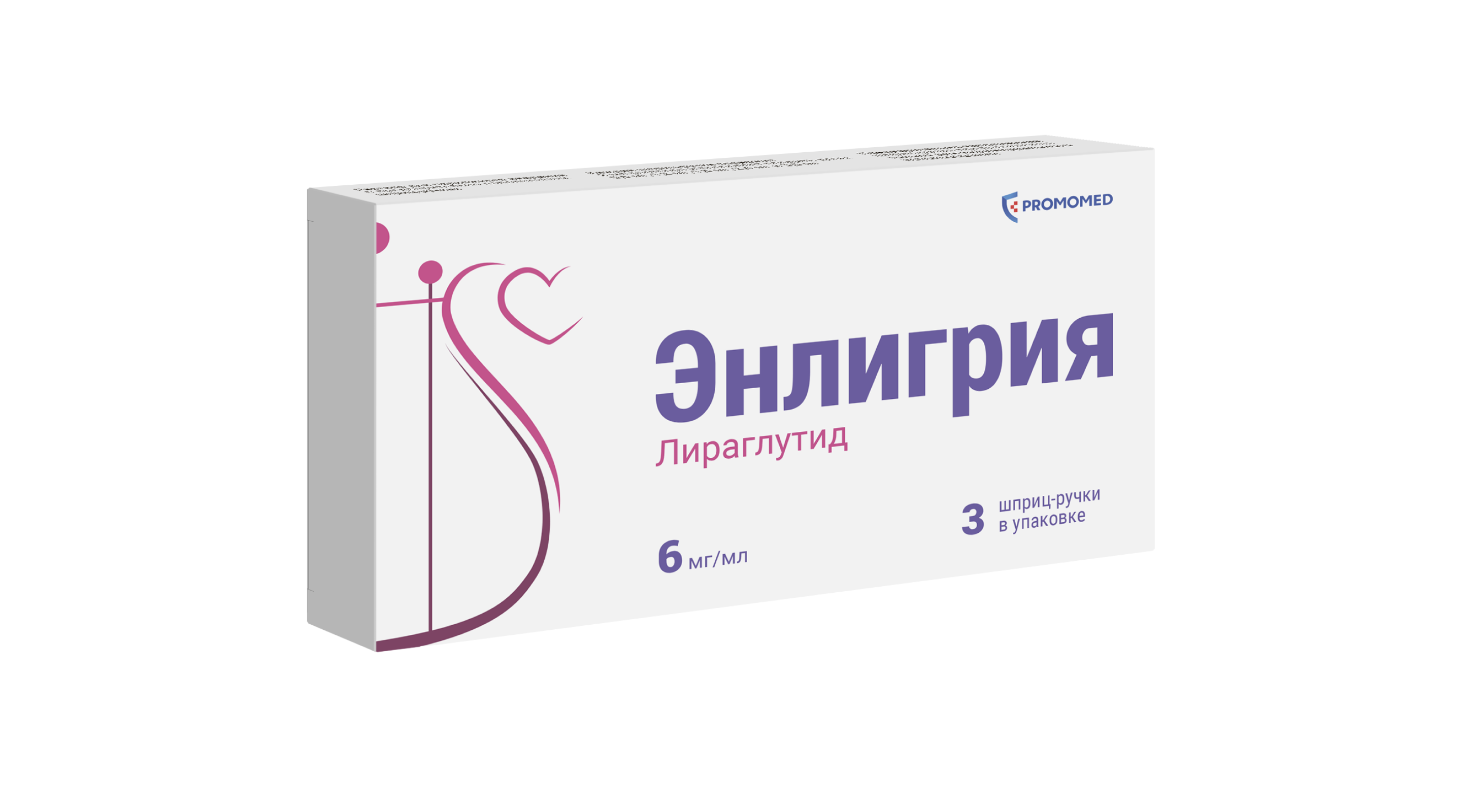
Enligria®
Dosage form
Solution for subcutaneous administration
Nosological classification
Drugs for the treatment of diabetes mellitus
INN
Liraglutide
Dosages
6 mg/ml
ATC code
A10BJ02
Active substance
Liraglutide - 6.0 mg
Pharmacotherapeutic group
Endocrinological preparations
use
Enligria is intended for subcutaneous administration only. It should not be administered intravenously or intramuscularly.
The drug Enligria is administered once a day at any time, regardless of food intake. It should be injected into the abdomen, hip, or shoulder area. The place and time of injection can be changed without dose adjustment. However, it is advisable to give injections at about the same time of day after choosing the most convenient time.
DosesAdults.
The initial dose is 0.6 mg per day. The dose is increased to 3.0 mg per day, adding 0.6 mg at intervals of at least one week to improve gastrointestinal tolerance. If, with an increase in the dose, the new dose is poorly tolerated by the patient for 2 consecutive weeks, discontinuation of therapy should be considered.
The use of the drug in a daily dose of more than 3.0 mg is not recommended.
Treatment with Enligria should be discontinued if, after 12 weeks of using the drug at a dose of 3.0 mg per day, the body weight loss was less than 5% of the baseline value.
Teenagers (≥ 12 years old)
For adolescents aged 12 to 18 years, the same dose increase regimen should be used as for adults. The dose of the drug should be increased until the value of 3.0 mg (therapeutic dose) or the maximum tolerated dose is reached.
The use of the drug in a daily dose of more than 3.0 mg is not recommended.
Enligria therapy should be discontinued and reviewed if, after 12 weeks of using the drug at a dose of 3.0 mg per day or the maximum tolerated dose, patients have lost less than 4% of their BMI or z-index of BMI.
Missed dose If less than 12 hours have passed after the usual dose administration time, the patient should administer the dose as soon as possible. If there are less than 12 hours left before the usual time for the next dose, the patient should not administer the missed dose, but should resume administration of the drug from the next scheduled dose. An additional or increased dose should not be administered to compensate for a missed dose.
The drug Enligria is administered once a day at any time, regardless of food intake. It should be injected into the abdomen, hip, or shoulder area. The place and time of injection can be changed without dose adjustment. However, it is advisable to give injections at about the same time of day after choosing the most convenient time.
DosesAdults.
The initial dose is 0.6 mg per day. The dose is increased to 3.0 mg per day, adding 0.6 mg at intervals of at least one week to improve gastrointestinal tolerance. If, with an increase in the dose, the new dose is poorly tolerated by the patient for 2 consecutive weeks, discontinuation of therapy should be considered.
The use of the drug in a daily dose of more than 3.0 mg is not recommended.
Treatment with Enligria should be discontinued if, after 12 weeks of using the drug at a dose of 3.0 mg per day, the body weight loss was less than 5% of the baseline value.
Teenagers (≥ 12 years old)
For adolescents aged 12 to 18 years, the same dose increase regimen should be used as for adults. The dose of the drug should be increased until the value of 3.0 mg (therapeutic dose) or the maximum tolerated dose is reached.
The use of the drug in a daily dose of more than 3.0 mg is not recommended.
Enligria therapy should be discontinued and reviewed if, after 12 weeks of using the drug at a dose of 3.0 mg per day or the maximum tolerated dose, patients have lost less than 4% of their BMI or z-index of BMI.
Missed dose If less than 12 hours have passed after the usual dose administration time, the patient should administer the dose as soon as possible. If there are less than 12 hours left before the usual time for the next dose, the patient should not administer the missed dose, but should resume administration of the drug from the next scheduled dose. An additional or increased dose should not be administered to compensate for a missed dose.
Help
Package leaflet
The active ingredient of Enligria, liraglutide, is a chemically synthesized peptide that is an acylated analog of human GLP-1, having 97% homology with the amino acid sequence of endogenous human GLP-1.
Liraglutide binds to and activates the GLP-1 receptor (GLP-1P). Liraglutide is resistant to metabolic degradation, and its plasma half-life after subcutaneous administration is 13 hours.
Adults
Enligria is indicated as an adjunct to a low-calorie diet and increased physical activity for long-term use in order to correct body weight in adult patients with BMI:
- ≥ 30 kg/m2 (obese) or
- ≥ 27 kg/m2 to <30 kg/m2 (overweight) in the presence of at least one overweight-related concomitant disease, such as prediabetes, type 2 diabetes mellitus, hypertension, dyslipidemia, or obstructive sleep apnea syndrome.
Teens
The drug Enligria can be used as an adjunct to a healthy diet and increased physical activity in order to correct body weight in adolescents aged 12 years and older with:
- body weight> 60 kg and
- obesity (BMI corresponding to ≥ 30 kg/m2 for adults according to international thresholds)*.
According to the CI and post-marketing use of liraglutide, cases of overdose have been reported when using the drug at a dose of up to 72 mg (24 times the recommended dose for body weight correction).
Patients reported severe nausea, severe vomiting, and severe hypoglycemia.
In case of overdose, appropriate supportive therapy should be initiated in accordance with the clinical signs and symptoms.
The patient should be monitored for clinical signs of dehydration and blood glucose concentration should be monitored.
The safety of liraglutide was evaluated in 5 double-blind, placebo-controlled trials involving 5,813 obese or overweight adult patients with at least one overweight-related comorbidity. Overall, gastrointestinal disorders were the most frequently reported adverse reactions during liraglutide therapy (67.9%) (see the subsection "Description of individual adverse reactions" in the instruction leaflet).
- Hypersensitivity to liraglutide or any of the excipients of the drug
- History of medullary thyroid cancer, including family history
- Multiple endocrine neoplasia type 2
- Severe depression, suicidal thoughts or behavior, including a history.
It is contraindicated in the following patient groups and in the following conditions / diseases due to the lack of data on efficacy and safety:
- severe renal insufficiency (creatinine clearance <30 ml/min);
- severe liver failure;
- children under 12 years of age;
- adolescents aged 12 to 18 years with a body weight of <60 kg;
- in patients aged ≥ 75 years;
- the period of pregnancy and breastfeeding;
- chronic heart failure (CHF) of functional class IV (according to the NYHA (New York Heart Association) classification);
- simultaneous use of other drugs for body weight correction;
- use in combination with other GLP-1 receptor agonists;
- secondary obesity due to endocrinological diseases or eating disorders, or due to the use of medications that can lead to weight gain.
In patients with diabetes mellitus, liraglutide should not be used as an insulin substitute.
The experience of using liraglutide in patients with inflammatory bowel diseases and diabetic gastric paresis is limited. The use of liraglutide in such patients is not recommended because it is associated with transient adverse reactions from the gastrointestinal tract, including nausea, vomiting and diarrhea.
Medicinal substances added to liraglutide can cause the destruction of liraglutide. Due to the lack of compatibility studies, this medicinal product should not be mixed with other medicinal products.
Manufacturer
JSC Biochemist, Russia.
Legal address: 15A Vasenko St., Saransk, 430030, Republic of Mordovia.
The address of the place of production: 430030, Republic of Mordovia, Saransk, Vasenko str., 15A.
Phone: (8342) 38-03-68
E-mail: biohimic@biohimic.ru
PROMOMED RUS LLC, Russia. 13 Mira Ave., building 1, Moscow, 129090.
Phone: 8-800-777-86-04 (free of charge), 8-495-640-25-28.
E-mail: reception@promo-med.ru
The organization that accepts consumer claims:
PROMOMED RUS LLC, 13 Mira Avenue, building 1, office 13, Moscow, 129090, Russia
Phone: +7 (495) 640-25-28
24-hour pharmacovigilance hotline: 8-800-777-86-04 (free of charge)
Email address: geception@promo-med.ru
Keep out of reach of children. Store at a temperature of 2 to 8 degrees Celsius. Store in the original packaging (pack). Store the used pen with the drug at a temperature of no more than 30 ° C or in the refrigerator (at a temperature of 2 to 8 ° C). Use it for 1 month. Cover the pen with a cap to protect it from light. Do not freeze the drug.
Liraglutide has no or negligible effect on the ability to drive vehicles and mechanisms. However, there is a risk of dizziness, mainly during the first 3 months of treatment with Enligria. If dizziness occurs, care should be taken when driving a vehicle or working with mechanisms. Due to the risk of hypoglycemia when using the drug, especially when combined with sulfonylureas in patients with DM2, caution should be exercised when driving vehicles and mechanisms.
our partners
Where to buy