
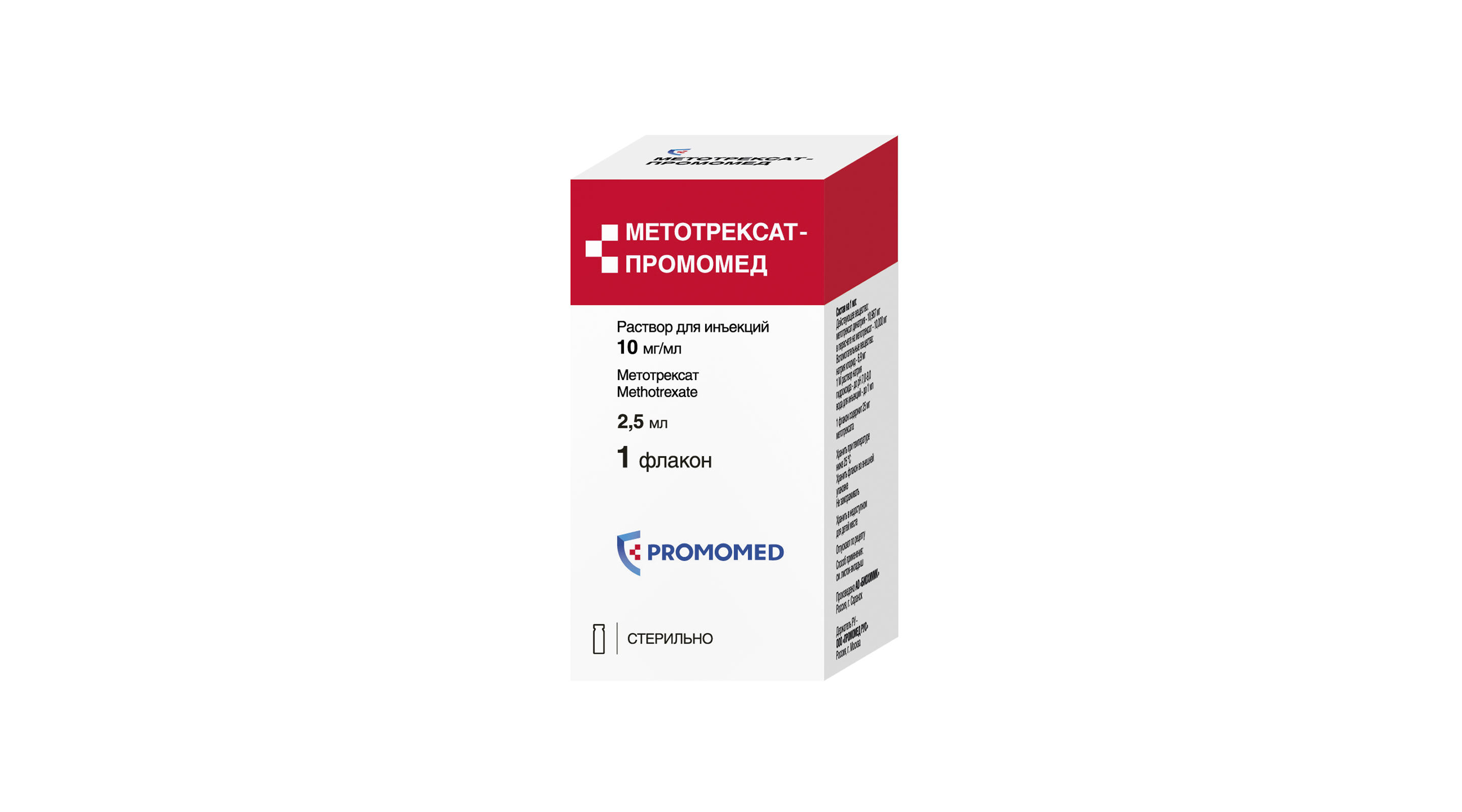

about the product
The drug Methotrexate-Promomed is a solution for injection, externally it is a transparent yellow to orange liquid.
Specifications
Name
Methotrexate-Promomed
Dosage form
Solution for injection
Nosological classification
Antitumor drugs
INN
Methotrexate
Dosages
10 mg/ml
ATC code
L01BA01
Active substance
Methotrexate
Pharmacotherapeutic group
Cancer drugs
use
Always use the drug in full accordance with the recommendations of your doctor. If in doubt, consult your doctor.
The drug Methotrexate-Promomed in the dosage form of a solution for injection can be administered intramuscularly, subcutaneously, intravenously, intraarterially or intrathecally – this is a method of injection into the spinal canal.
Recommended dose
Trophoblastic tumors: 15-30 mg intramuscularly, daily for 5 days with an interval of one or more weeks (depending on signs of toxicity). Or 50 mg once every 5 days with an interval of at least 1 month. Treatment courses are usually repeated 3 to 5 times to a total dose of 300-400 mg.
Solid tumors: in combination with other antitumor drugs, 30-40 mg/ m2 intravenously once a week.
Leukemias and lymphomas: 200-500 mg/m2 by intravenous infusion once every 2-4 weeks.
Neuroleukemia: 12 mg/m2 intrathecally for 15-30 seconds 1 or 2 times a week. Before administration, cerebrospinal fluid is removed in a volume approximately equal to the volume of the drug to be administered.
Fungal mycosis Intramuscularly 50 mg once a week or 25 mg twice a week for several weeks or months. Reducing the dose or discontinuing the drug is determined by the patient's reaction and hematological parameters.
Dermatomyositis: 7.5–15 mg per week. Subsequently, the dose is reduced to the lowest effective dose and used for a long time, for months, in combination with a maintenance dose of glucocorticosteroids.
Systemic lupus erythematosus: adults: 15 mg per week; children: 7.5–10 mg/m2. The course of treatment is 6-8 weeks, then a maintenance dose is applied for many months.
Psoriasis and psoriatic arthritis: the recommended initial dose is 7.5 mg of methotrexate once a week intramuscularly, intravenously or subcutaneously. The dose should be gradually increased, with the maximum dose not exceeding 30 mg of methotrexate per week. The response to treatment usually occurs 2-6 weeks after the start of the drug. When the optimal clinical effect is achieved, the dose is reduced until the lowest effective dose is reached.
Rheumatoid arthritis: the initial dose is usually 7.5 mg once a week, which is administered simultaneously intravenously, intramuscularly or subcutaneously. To achieve optimal effect, the weekly dose can be gradually increased (2.5 mg per week), but it should not exceed 20 mg. When the optimal clinical effect is achieved (usually 4-8 weeks after the start of therapy), dose reduction should be initiated until the lowest effective maintenance dose is reached. The optimal duration of therapy has not been established; in each specific case, the duration of therapy is determined by the doctor.
Use in children and adolescents
Due to limited data on the efficacy and safety of methotrexate in children under 3 years of age, it is not recommended to use the drug in this group of patients. When using methotrexate in children as an immunosuppressive therapy (for psoriasis, rheumatoid arthritis, juvenile chronic arthritis, dermatomyositis, and systemic lupus erythematosus), the benefit/risk ratio should be carefully considered.
Route and method of administration
The drug will be administered to you in one of the following ways: intramuscularly, subcutaneously, intravenously, intraarterially or intrathecally (injection into the spinal / spinal canal).
Help
Package leaflet
Antitumor, cytostatic agent (disrupts the growth and development of all body cells, including malignant ones) of the group of antimetabolite analogues of folic acid, which has immunosuppressive (artificially suppresses immunity) and anti-inflammatory effects.
In people with rheumatoid arthritis (an inflammatory joint disease), the use of methotrexate reduces the symptoms of inflammation (pain, swelling, stiffness). In psoriasis, the growth rate of keratinocytes (this is a type of cell) in psoriatic plaques (pink-red rashes on the skin) increases compared to the normal proliferation of skin cells. This difference in cell proliferation is the basis for the use of methotrexate for the treatment of psoriasis.
The drug Methotrexate-Promomed is used for the treatment of children aged 3 years and older and adults with:
− trophoblastic tumors are a group of precancerous and malignant hormone–producing neoplasms;
− acute leukemia is an oncological disease (especially lymphoblastic and myeloblastic variants);
− neuroleukemia is one of the severe complications of acute leukemia;
− non-Hodgkin's lymphoma is an accumulation of malfunctioning immune cells in the tissues that disrupt the functioning of vital organs and systems, including lymphosarcoma (malignant tumor);
− breast cancer, squamous cell carcinoma of the head and neck, lung cancer, skin cancer, cervical cancer, vulvar cancer (external pelvic genitalia of a woman), esophageal cancer, kidney cancer, bladder cancer, testicular cancer, ovarian cancer, penile cancer, retinoblastoma (malignant tumor of the retina), medulloblastoma (malignant brain tumor);
− osteogenic sarcoma (malignant tumor growing from bone tissue cells) and soft tissue sarcoma (malignant tumor);
− fungal mycosis (advanced stage) is a malignant tumor of lymphoid tissue;
− severe forms of psoriasis (a chronic disease affecting the skin), psoriatic arthritis (long-term inflammatory arthritis), rheumatoid arthritis (inflammatory joint disease), juvenile chronic arthritis (arthritis of unknown cause), dermatomyositis (a long-term inflammatory disease that affects the skin), systemic lupus erythematosus (a chronic disease in which the body's immune system it becomes overactive and affects healthy tissues), ankylosing spondylitis is a type of arthritis in which there is prolonged inflammation of the joints of the spine (with the ineffectiveness of standard therapy).
Mainly, there are symptoms associated with suppression of the hematopoiesis system.
If an overdose has occurred, your doctor will prescribe the appropriate treatment for you.
The specific antidote of methotrexate is calcium folinate. It neutralizes the adverse toxic effects.
In case of accidental overdose, calcium folinate is administered (intravenously or intramuscularly) at a dose equal to or greater than the dose of methotrexate no later than one hour after administration of methotrexate.
In case of significant overdose, hydration of the body (saturation of body tissues with moisture) and alkalinization of urine (pH greater than 7) may be required to prevent precipitation of methotrexate and/or its metabolites in the renal tubules. Hemodialysis (one of the methods of extrarenal blood purification) and peritoneal dialysis (extrarenal cleansing of the body) do not improve the elimination of methotrexate.
Intensive intermittent hemodialysis (using an artificial kidney device) allows for effective purification from methotrexate
Like all medications, the drug Methotrexate-Promomed can cause undesirable reactions, but they do not occur in everyone.
It is important that you inform your doctor about any adverse reactions that occur so that he can take appropriate measures (for example, temporarily suspend or cancel treatment, change the dose and duration of the drug, or prescribe additional therapy).
The frequency and severity of adverse reactions usually depend on the dose and duration of treatment with methotrexate. Since severe adverse reactions can occur even
When using low doses and at any time during treatment, regular monitoring is necessary.
follow-up by the attending physician at short intervals. Majority
adverse reactions are reversible with early detection. However, some of the specified
The following severe adverse reactions in very rare cases may cause sudden
death.
If an adverse reaction occurs, the dose should be reduced or temporarily discontinued.
treatment depends on the severity and intensity of the reaction, as well as take
appropriate measures.
(For more information about all possible adverse reactions, see the leaflet)
Do not use the drug Methotrexate-Promomed in the following cases
When applied across all indicators:
− if you are allergic to methotrexate or any other components of the drug (listed in section 6 of the leaflet);
− if you have severe renal insufficiency (creatinine clearance less than 30 ml/min) when using methotrexate in low doses (<100 mg/m2) and moderate renal insufficiency (creatinine clearance less than 60 ml/min) when using methotrexate in high doses (>100 mg/m2);
− severe liver dysfunction (concentration of bilirubin in blood plasma more than 5 mg/dl (85.5 mmol/l));
− if you have or have previously had a history of disorders of the hematopoiesis system (in particular, suppression of hematopoiesis (bone marrow hypoplasia), decreased white blood cell count (leukopenia), decreased platelet count (thrombocytopenia) or decreased red blood cell and hemoglobin levels with clinical signs, such as tinnitus, headache, dizziness (clinically significant anemia));
− if you have severe acute and chronic infectious diseases such as tuberculosis and human immunodeficiency virus (HIV infection);
− if you have a pronounced weakening of the immune system, accompanied by weakness and frequent infections (immunodeficiency);
− if you are pregnant;
− if you are breastfeeding;
− if you are simultaneously using methotrexate at a dose of 15 mg/week. and more in combination with acetylsalicylic acid.
Tell your doctor that you are taking, have recently taken, or may start taking any other medications.
Your doctor needs to know about the medications you are taking in order to take into account possible adverse reactions that may develop due to the interaction of various drugs with the drug Methotrexate-Promomed, and possibly adjust the doses of the medications you are taking.
(For more information about the entire list, see the instructions in the leaflet)
The holder of the registration certificate
JSC Biochemist, Russian Federation
15A Vasenko St., Saransk, 430030, Republic of Mordovia
Manufacturer
JSC Biochemist, Russian Federation
Address: 15A Vasenko St., Saransk, 430030, Republic of Mordovia
Phone: +7 (8342) 38 03 68
Email: biohimic@promomed.pro
Internet address: promomed.pro
The organization that accepts consumer claims
JSC Biochemist, Russian Federation
Address: 15A Vasenko St., Saransk, 430030, Republic of Mordovia
Phone number: 8 800 222 95 63; 8 800 777 86 04 ( around the clock)
Email: hot_line@promomed.pro
Do not use the drug after the expiration date indicated on the bottle and the cardboard pack after "Good before:". The expiration date is the last day of the specified month. Keep the drug out of the reach of the child so that the child cannot see it. Store at temperatures below 25 °C. Keep the vial/syringe in the outer packaging. Do not freeze.
Due to limited data on the efficacy and safety of methotrexate in children under 3 years of age, it is not recommended to use the drug in this group of patients. When using methotrexate in children as an immunosuppressive therapy for immune suppression (in psoriasis, rheumatoid arthritis, juvenile chronic arthritis, dermatomyositis, and systemic lupus erythematosus), the benefit/risk ratio is carefully considered.
our partners
Where to buy