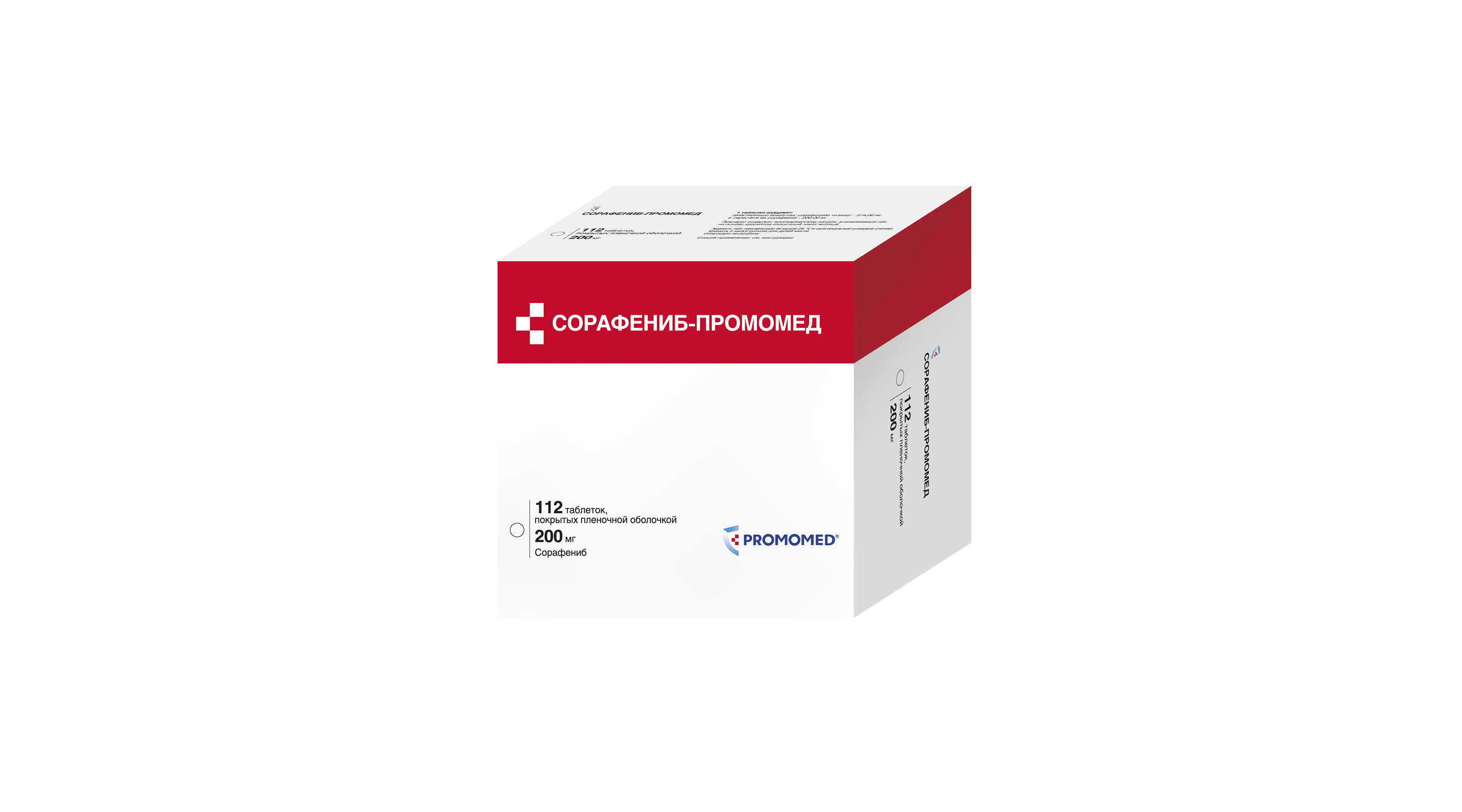

about the product
The tablets are round, biconvex, and yellow film-coated. In the cross-section, the core is white or almost white.
Specifications
Name
Sorafenib-Promomed
Dosage form
FILM-COATED TABLETS
Nosological classification
Antitumor drugs
INN
SORAFENIB
Dosages
200 mg
ATC code
L01EX01
Active substance
sorafenib tosilate – 274 mg in terms of sorafenib - 200 mg
Pharmacotherapeutic group
Cancer drugs
use
The
recommended daily dose of Sorafenib-Promomed is 800 mg (4 tablets of 200 mg each). The daily dose is prescribed in two doses (2 tablets 2 times a day) either in between meals, or together with food containing a low or moderate amount of fat. Tablets are swallowed with a glass of water. If the patient intends to eat a high-fat meal, sorafenib tablets should be taken at least 1 hour before or 2 hours after a meal.
Treatment is continued as long as the clinical efficacy of the drug remains or until its unacceptable toxic effects appear. The development of possible adverse drug reactions may require temporary discontinuation and/or reduction of the dose of Sorafenib-Promomed.
Dose reduction in patients with metastatic renal cell carcinoma and hepatic cell carcinoma
If necessary, the dose of Sorafenib-Promomed can be reduced to 400 mg once a day or to 400 mg every other day.
Dose reduction in patients with differentiated thyroid cancer
If it is necessary to reduce the dose of Sorafenib-Promomed to 600 mg per day, the drug is taken 2 times a day (2 tablets and 1 tablet with an interval of 12 hours) .
Treatment is continued as long as the clinical efficacy of the drug remains or until its unacceptable toxic effects appear. The development of possible adverse drug reactions may require temporary discontinuation and/or reduction of the dose of Sorafenib-Promomed.
Dose reduction in patients with metastatic renal cell carcinoma and hepatic cell carcinoma
If necessary, the dose of Sorafenib-Promomed can be reduced to 400 mg once a day or to 400 mg every other day.
Dose reduction in patients with differentiated thyroid cancer
If it is necessary to reduce the dose of Sorafenib-Promomed to 600 mg per day, the drug is taken 2 times a day (2 tablets and 1 tablet with an interval of 12 hours) .
Help
Package leaflet
Sorafenib is a multikinase inhibitor. Reduces the proliferation of tumor cells in vitro. Sorafenib has been shown to inhibit numerous intracellular kinases (c-CRAF, BRAF, and mutant BRAF) and kinases located on the cell surface (KIT, FLT-3, RET, VEGFR-1, VEGFR-2, VEGFR-3, and PDGFR-β). It is believed that some of these kinases are involved in the signaling systems of the tumor cell, in the processes of angiogenesis and apoptosis. Sorafenib inhibits tumor growth in hepatic cell carcinoma, renal cell carcinoma, and differentiated thyroid cancer in humans.
- Metastatic renal cell carcinoma
- Liver cell carcinoma
- Locally advanced or metastatic differentiated thyroid cancer resistant to radioactive iodine.
Symptoms: the clinically studied maximum dose of sorafenib is 800 mg twice daily. The adverse events observed at this dose were primarily diarrhea and skin reactions.
Treatment: symptomatic. The antidote to sorafenib is unknown.
The most serious adverse reactions when taking Sorafenib-Prommed were myocardial infarction/coronary heart disease, gastrointestinal perforation, drug-induced hepatitis, bleeding, and hypertension/hypertensive crisis.
The most common adverse reactions were diarrhea, fatigue, alopecia, infection, skin reaction of the feet and hands (corresponding to palmar-plantar erythrodysesthesia syndrome in the MedDRA dictionary) and rash.
(For more information about all possible adverse reactions, see the leaflet)
- Hypersensitivity to sorafenib or any other component of the drug
- Pregnancy
- Breastfeeding period
- Children under 18 years of age (efficacy and safety of use have not been established)
CYP3A4 inducers
Drugs that induce CYP3A4 activity (for example, rifampicin, phenytoin, carbamazepine, phenobarbital, dexamethasone and preparations containing St. John's wort extract) can increase the metabolism of sorafenib and, thus, reduce its concentration in the body.
Prolonged simultaneous administration of sorafenib with rifampicin resulted in a decrease in sorafenib AUC by an average of 37%.
CYP3A4 inhibitors
Clinical pharmacokinetic interactions of sorafenib with cytochrome CYP3A4 inhibitors are unlikely.
CYP2C9 substrates
Concomitant administration of sorafenib and warfarin did not result in a change in the mean values of prothrombin time and INR compared with placebo. However, regular INR assessment is recommended for all patients receiving concomitant therapy with warfarin and sorafenib.
(For more information about the entire list, see the instructions in the leaflet)
Registration certificate holder
JSC Biochemist, Russian Federation
15A Vasenko St., Saransk, Republic of Mordovia, 430030
Manufacturer
JSC Biochemist, Russian Federation
Address: 15A Vasenko str., Saransk, 430030, Republic of Mordovia
Phone number: +7 (8342) 38 03 68
Email: biohimic@promomed.pro
Internet address: promomed.ru
An organization that accepts consumer claims
JSC Biochemist, Russian Federation
Address: 15A Vasenko str., Saransk, 430030, Republic of Mordovia
Phone number: 8 800 222 95 63; 8 800 777 86 04 ( around the clock)
Email: hot_line@promomed.pro
Store at a temperature not exceeding 25 ° C. Store in the original packaging (pack) to protect from light. Keep out of reach of children.
3 years. Do not use after the expiration date.
They are available on prescription.
our partners
Where to buy