
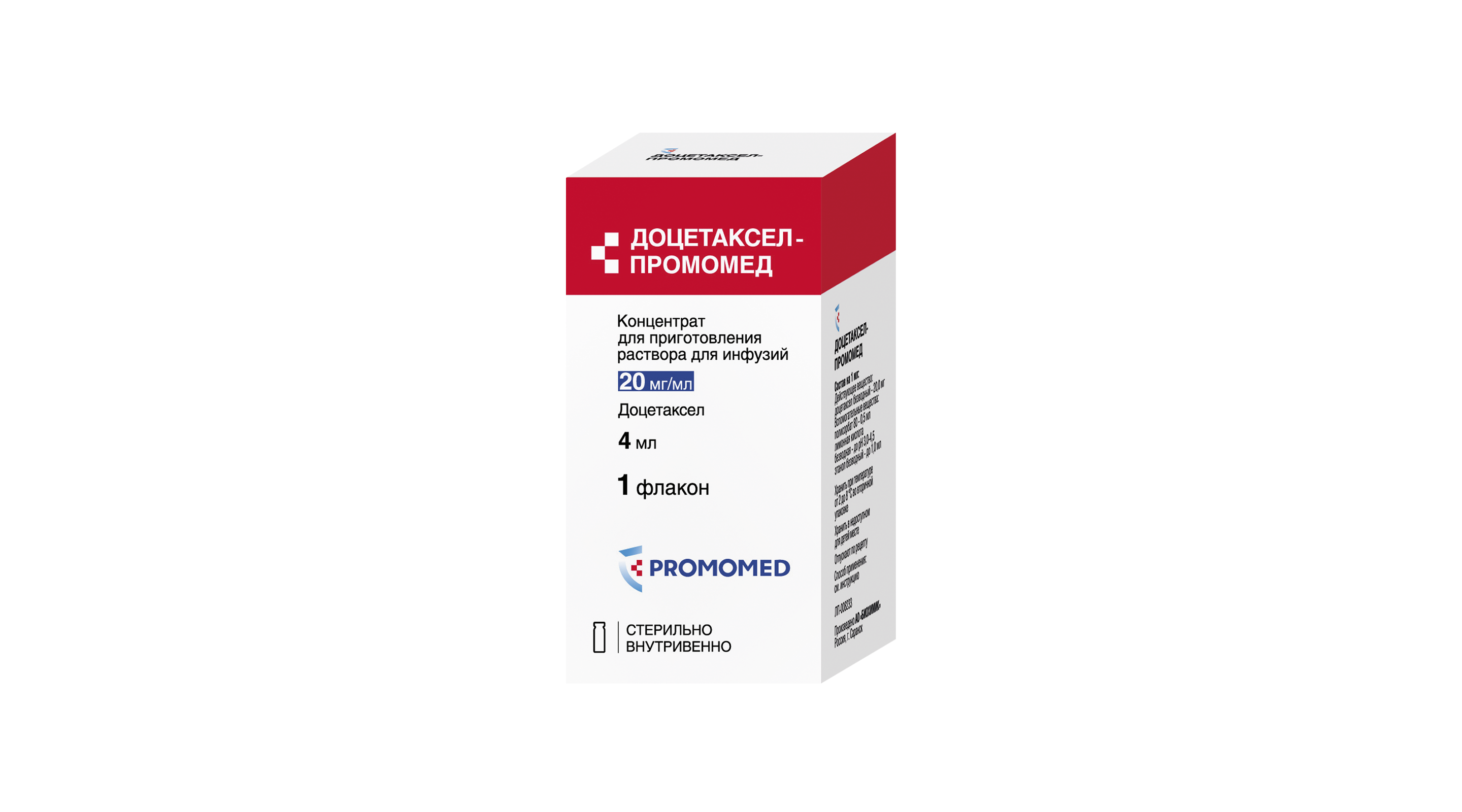

about the product
A clear oily solution of light yellow or brownish yellow color.
Specifications
Name
Docetaxel-Promomed
Dosage form
Concentrate for preparation of infusion solution
Nosological classification
Antitumor drugs
INN
Docetaxel
Dosages
10 mg/ml; 20 mg/ml; 40 mg/ml
ATC code
L01CD02
Active substance
docetaxel
Pharmacotherapeutic group
Cancer drugs
use
Treatment with Docetaxel-Promomed should be carried out only under the supervision of a doctor who has experience in conducting antitumor chemotherapy in a specialized hospital.
To prevent the development of hypersensitivity reactions, as well as to reduce fluid retention, all patients receiving Docetaxel-Promomed (except patients with prostate cancer, for whom see below for recommendations on premedication) are premedicated with a glucocorticosteroid, for example, dexamethasone orally at a dose of 16 mg /day (8 mg each twice a day) for 3 days, starting 1 day before the administration of Docetaxel-Promomed.
In patients with metastatic castration-resistant prostate cancer receiving concomitant treatment with prednisone or prednisone, oral dexamethasone premedication is performed at a dose of 8 mg 12 hours, 3 hours and 1 hour before the start of Docetaxel-Promomed administration.
In patients with metastatic hormone-sensitive prostate cancer, regardless of the simultaneous use of prednisone or prednisone, oral dexamethasone premedication is performed at a dose of 8 mg 12 hours, 3 hours and 1 hour before the start of Docetaxel-Promomed administration.
Prophylactic administration of granulocyte colony stimulating factor (G-CSF) is recommended to reduce the risk of hematological toxicity.
Docetaxel-Promomed is administered by one-hour intravenous infusion once every 3 weeks.
To prevent the development of hypersensitivity reactions, as well as to reduce fluid retention, all patients receiving Docetaxel-Promomed (except patients with prostate cancer, for whom see below for recommendations on premedication) are premedicated with a glucocorticosteroid, for example, dexamethasone orally at a dose of 16 mg /day (8 mg each twice a day) for 3 days, starting 1 day before the administration of Docetaxel-Promomed.
In patients with metastatic castration-resistant prostate cancer receiving concomitant treatment with prednisone or prednisone, oral dexamethasone premedication is performed at a dose of 8 mg 12 hours, 3 hours and 1 hour before the start of Docetaxel-Promomed administration.
In patients with metastatic hormone-sensitive prostate cancer, regardless of the simultaneous use of prednisone or prednisone, oral dexamethasone premedication is performed at a dose of 8 mg 12 hours, 3 hours and 1 hour before the start of Docetaxel-Promomed administration.
Prophylactic administration of granulocyte colony stimulating factor (G-CSF) is recommended to reduce the risk of hematological toxicity.
Docetaxel-Promomed is administered by one-hour intravenous infusion once every 3 weeks.
Help
Package leaflet
Docetaxel-Promomed is an antitumor drug of plant origin (from the group of taxoids). It stabilizes tubulin in microtubules, prevents their decay, which disrupts the process of division of tumor cells. Docetaxel remains in cells for a long time, where its concentration reaches high values. In addition, docetaxel is active against some, though not all, cells that produce excessive amounts of P-glycoprotein (P-gP), encoded by the gene for multiple resistance to chemotherapeutic drugs. In vivo, docetaxel has a wide range of activity against mouse tumors and transferable human tumor cells.
- Breast cancer (BC)
- Non-small cell lung cancer
- Ovarian cancer
- Prostate cancer
- Stomach cancer (adenocarcinoma)
- Head and neck cancer
There are a small number of reports of overdose. The main manifestations of overdose were suppression of bone marrow function, peripheral neurotoxicity, and mucositis (inflammation of the mucous membranes).
Monotherapy with Docetaxel-Promomed (75 mg/m2 and 100 mg/m2)
Disorders of the blood and lymphatic system
Very common: Reversible and non-cumulative (does not increase with repeated administration) Neutropenia was observed in 96.6% of patients who did not receive G-CSF.
Febrile neutropenia, infections, anemia (hemoglobin <11 g/dl).
Often: Severe infections combined with a decrease in the number of neutrophils in peripheral blood <500/ml; severe infections, including sepsis and pneumonia, including fatal; thrombocytopenia <100,000/ml; bleeding combined with thrombocytopenia <50,000/ml, severe anemia (hemoglobin <8 g/dl).
Infrequently: Severe thrombocytopenia.
Disorders of the immune system
Very common: Allergic reactions, which usually occur within a few minutes after the start of intravenous infusion of Docetaxel Promomed, are mild or moderate ("flushes" of blood to the skin; rash combined with and without itching; chest tightness; back pain; shortness of breath; drug fever or chills).
Often: Severe allergic reactions characterized by a decrease in blood pressure and / or bronchospasm or generalized rash/ erythema (resolved after discontinuation of intravenous infusion and appropriate therapy).
− A history of severe hypersensitivity reactions to docetaxel or polysorbate 80.
− The number of neutrophils in peripheral blood <1500/ ml.
− Severe liver dysfunction.
− Pregnancy and breastfeeding.
− Children under 18 years of age.
The ethanol contained in this dosage form may alter the effect of other medications.
In vitro studies have shown that the biotransformation of the drug can change with the simultaneous use of substances that induce or inhibit cytochrome CYP3A isoenzymes, or are metabolized with their help, such as cyclosporine, terfenadine, erythromycin and troleandomycin. In this regard, caution should be exercised when using such drugs at the same time, given the possibility of a pronounced interaction.
When used concomitantly with strong inhibitors of the CYP3A4 isoenzyme, the incidence of side effects of Docetaxel-Promomed may increase due to a slowdown in its metabolism.
The holder of the registration certificate
JSC Biochemist, Russian Federation
15A Vasenko St., Saransk, 430030, Republic of Mordovia
Manufacturer
JSC Biochemist, Russian Federation
Address: 15A Vasenko St., Saransk, 430030, Republic of Mordovia
Phone: +7 (8342) 38 03 68
Email: biohimic@promomed.pro
Internet address: promomed.pro
The organization that accepts consumer claims
JSC Biochemist, Russian Federation
Address: 15A Vasenko St., Saransk, 430030, Republic of Mordovia
Phone number: 8 800 222 95 63; 8 800 777 86 04 ( around the clock)
Email: hot_line@promomed.pro
Store in the refrigerator (2-8 ° C). Store in the original packaging (pack/box). Keep out of reach of children.
2 years. Do not use after the expiration date.
They are available on prescription.
Women of reproductive age and men receiving docetaxel treatment are advised to avoid pregnancy and conception, and to inform their doctor immediately if this happens. Docetaxel is contraindicated for use during pregnancy. If women become pregnant during treatment, they should immediately inform their doctor about this.
our partners
Where to buy