
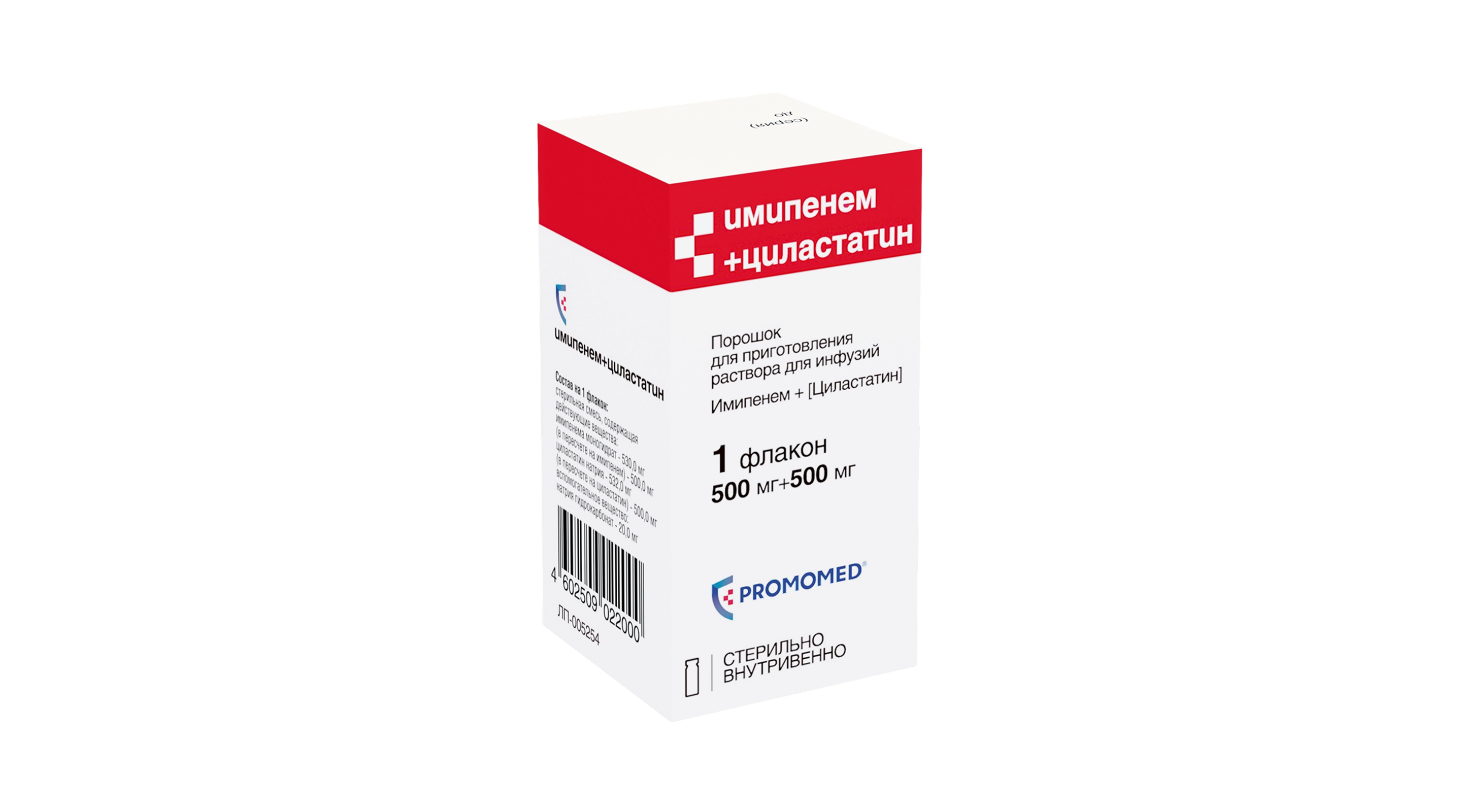

about the product
White or white powder with a yellowish tinge.
Beta-lactam broad-spectrum antibiotic. It suppresses bacterial cell wall synthesis and has a bactericidal effect against a wide range of Gram-positive and Gram-negative microorganisms, aerobic and anaerobic
Specifications
Name
Imipenem+Cilastatin
Dosage form
POWDER FOR PREPARATION OF INFUSION SOLUTION
Nosological classification
Antibacterial drugs of systemic action
INN
Imipenem+[Cilastatin]
Dosages
500 mg + 500 mg
ATC code
J01DH51
Active substance
active ingredients: imipenem monohydrate - 530.0
mg (in terms of imipenem – 500.0 mg),
cilastatin sodium - 532.0 mg
(in terms of cilastatin - 500.0 mg);
Pharmacotherapeutic group
Antibacterial
use
THE
DOSAGE FORM FOR INTRAVENOUS ADMINISTRATION SHOULD NOT BE ADMINISTERED INTRAMUSCULARLY.
The
dosage recommendations for Imipenem+Cilastatin indicate the amount of imipenem to be administered.
The calculation of the total daily dose of Imipenem + Cilastatin should be based on the severity of the infection and distributed over several applications in equal doses, taking into account the degree of sensitivity of one or more pathogenic microorganisms, kidney function and body weight.
Dosage regimen for adult patients with normal renal function
The doses shown in Table 1 are calculated for patients with normal renal function (creatinine clearance greater than 70 ml/min/1.73 m2) and body weight ≥70 kg. In patients with creatinine clearance <70 ml /min / 1.73 m 2 (see Table 2) and / or body weight less than 70 kg (see Table 3), it is necessary to reduce the dose of the drug. It is especially important to reduce the dose depending on body weight in those patients who have a weight significantly below 70 kg and/or have moderate or severe renal insufficiency. The average therapeutic daily dose is 1-2 g of imipenem, divided into 3-4 applications (see Table 1). For the treatment of moderate infections, the drug can also be used in a dose of 1 g twice a day.
In case of infections caused by less sensitive microorganisms, the daily dose of the drug for intravenous infusion can be increased to a maximum of 4 g (imipenem) per day or 50 mg/ kg per day, depending on which dose is lower. Each dose of Imipenem + Cilastatin for intravenous infusion, less than or equal to 500 mg, should be administered intravenously for 20-30 minutes. Each dose over 500 mg should be administered intravenously for 40-60 minutes. Patients who experience nausea during infusion should slow down the rate of administration of the drug.
Table 1. Dosage regimen of Imipenem+ Cilastatin for intravenous infusions in adult patients with normal renal function and body weight ≥70 kg*
|
Severity of infection |
The dose imipenem, mg |
Break between by infusions |
Total daily dose |
|
Easy |
250 mg |
6 hours |
1.0 g |
|
Average |
500 mg 1000 mg |
8 hours 12 hours |
1.5 g 2.0 g |
|
Heavy (sensitive pathogens) |
500 mg |
6 hours |
2.0 g |
|
Severe and/or threatening lives |
1000 mg |
8 hours |
3.0 g |
|
Severe and/or life-threatening, caused by less than sensitive microorganisms (primarily some strains of R. aeruginosa) |
1000 mg |
6 hours |
4.0 g |
Help
Package leaflet
The drug Imipenem + Cilastatin consists of two components: 1) imipenem, a broad-spectrum beta-lactam antibiotic, a thienamycin derivative belonging to the carbapenem group; 2) sodium cilastatin, an enzyme that inhibits imipenem metabolism in the kidneys and significantly increases the concentration of unchanged imipenem in the urinary tract.
Imipenem inhibits bacterial cell wall synthesis and has a bactericidal effect against a wide range of Gram-positive and Gram-negative aerobic and anaerobic microorganisms.
Cilastin does not have its own antibacterial activity, does not inhibit the beta-lactamase of bacteria.
The drug is used to treat severe infections caused by microorganisms sensitive to it, as well as for empirical therapy of the infectious process even before the identification of its bacterial pathogens.
- intraabdominal infections caused by Enterococcus faecalis, Staphylococcus aureus (penicillin-producing strains), Staphylococcus epidermidis, Citrobacter spp., Enterobacter spp., Escherichia coli, Klebsiella spp., Morganella morganii, Proteus spp., Pseudomonas aeruginosa, Bifidobacterium spp., Clostridium spp., Eubacterium spp., Peptococcus spp., Peptostreptococcus spp., Propionibacterium spp., Bacteroides spp., including B. fragilis, Fusobacterium spp.
- lower respiratory tract infections caused by Streptococcus pneumoniae, Staphylococcus aureus (penicillinase-producing strains), Acinetobacter spp., Enterobacter spp., Escherichia coli, Haemophilus influenzae, Haemophilus parainfluenzae, Klebsiella spp., Serratia marcescens. urinary tract infections (complicated and uncomplicated) caused by Enterococcus faecalis, Staphylococcus aureus (penicillinase-producing strains), Enterobacter spp., Escherichia coli, Klebsiella spp., Morganella morganii, Proteus vulgaris, Providencia rettgeri, Pseudomonas aeruginosa . skin and soft tissue infections caused by Streptococcus pyogenes, Enterococcus faecalis, Staphylococcus aureus (penicillinase-producing strains), Staphylococcus epidermidis, Acinetobacter spp., Citrobacter spp., Enterobacter spp., Escherichia coli, Klebsiella spp., Morganella morganii, Proteus vulgaris, Providencia rettgeri, Pseudomonas aeruginosa; Serratia spp., Peptococcus spp., Peptostreptococcus spp., Bacteroides spp., including B. fragilis, Fusobacterium spp.
- infections of bones and joints caused by Enterococcus faecalis, Staphylococcus aureus (penicillinase–producing strains), Staphylococcus epidermidis, Enterobacter spp., Pseudomonas aeruginosa.
- bacterial septicemia caused by Streptococcus pneumoniae, Enterococcus faecalis, Staphylococcus aureus (penicillinase-producing strains), Enterobacter spp., Escherichia coli, Klebsiella spp., Pseudomonas aeruginosa, Serratia spp., Bacteroides spp., including Bacteroides fragilis. infectious endocarditis caused by Staphylococcus aureus (penicillinase-producing strains). Gynecological infections caused by Enterococcus faecalis, Staphylococcus aureus (penicillinase-producing strains), Staphylococcus epidermidis, Streptococcus agalactiae (Streptococcus spp. group B), Enterobacter spp., Escherichia coli, Gardnerella vaginalis, Klebsiella spp. , Proteus spp., Bifidobacterium spp., Peptococcus spp., Peptostreptococcus spp., Propionibacterium spp., Bacteroides spp., including B. fragilis.
Overdose symptoms correspond to the profile of adverse reactions and may include seizures, confusion, tremor, nausea, vomiting, decreased blood pressure, and bradycardia.
There is no specific information on the treatment of overdose with Imipenem+ Cilastatin. Imipenem + cilastatin sodium is eliminated during hemodialysis, but the effectiveness of this procedure in case of drug overdose is unknown.
In clinical trials, Imipenem+[Cilastatin] was administered intravenously to 1,723 patients. The most common systemic side effects likely associated with the use of the drug were nausea (2.0%), diarrhea (1.8%), vomiting (1.5%), rash (0.9%), fever (0.5%), decreased blood pressure (0.4%), seizures (0.4%) (see section "Special instructions"), dizziness (0.3%), itching (0.3%), urticaria (0.2%), drowsiness (0.2%). The most common local side effects were phlebitis/thrombophlebitis (3.1%), pain at the injection site (0.7%), erythema at the injection site (0.4%) and scarring of the vein wall (0.2%). Increased activity of serum transaminases and alkaline phosphatase has also been frequently reported.
Children (older than 3 months)
In a clinical trial involving 178 children older than 3 months, the side effects observed were comparable to the side effects reported in adult patients.
- Hypersensitivity to any of the components of the drug; hypersensitivity to other carbapenems.
- Severe hypersensitivity reactions (e.g., anaphylactic reactions, severe skin reactions) to any other beta-lactam antibiotics (e.g., penicillins or cephalosporins).
- Children under 3 months old.
- Children with impaired renal function (serum creatinine> 2 mg/dl).
- Patients with creatinine clearance (creatinine clearance) less than 5 ml/min/1.73 m2 (except in cases where hemodialysis is performed no later than 48 hours after the infusion of the drug)
The drug is pharmaceutically incompatible with lactic acid (lactate) and should not be prepared on the basis of solvents containing it. However, the drug can be administered intravenously through the same infusion system as the lactate-containing solution.
Concomitant use with ganciclovir increases the risk of generalized seizures. These drugs should not be used simultaneously, except in cases where the potential benefits outweigh the potential risks.
Concomitant use with probenecid is accompanied by a minimal increase in the plasma concentration and half-life of imipenem, and therefore the simultaneous use of probenecid and the drug is not recommended.When using the drug with valproic acid or sodium divalproate, the plasma concentration of valproic acid decreases. As a result of this interaction, the concentration of valproic acid may fall below the therapeutic level, which increases the risk of seizures. Although the mechanism of interaction is unknown, in vitro data and animal studies suggest that carbapenems can inhibit hydrolysis, as a result of which the glucuronide metabolite of valproic acid (VPA-g) is converted back to valproic acid, which leads to a decrease in the concentration of valproic acid in blood plasma (see section "Special instructions").
The simultaneous use of antibacterial drugs with warfarin may enhance its anticoagulant effect. There are numerous reports of an increased anticoagulant effect of oral anticoagulants, including warfarin, in patients taking antibacterial drugs at the same time.The risk may vary depending on the infectious agent, age, and general condition of the patient, so it is difficult to assess the effect of antibiotics on increasing the international normalized ratio (INR). It is recommended to periodically monitor the INR value during and immediately after the simultaneous use of antibacterial drugs with oral anticoagulants.
The drug should not be mixed in the same syringe with other antibiotics, while simultaneous isolated administration with other antibiotics (aminoglycosides) is allowed.
The owner of the registration certificate
PROMOMED RUS LLC, Russia. 2/2 Pochtovaya str., building 1, room I, room 2, Moscow, 105005.
Manufacturer: JSC Biochemist, Russia.
Legal address: 15A Vasenko St., Saransk, 430030, Republic of Mordovia.
The address of the place of production: 430030, Republic of Mordovia, Saransk, Vasenko str., 15A.
Phone (8342) 38-03-68
E-mail: biohimic@biohimic.ruwww.biohimik.ru
The organization that accepts consumer claims
PROMOMED RUS LLC, Russia.
13 Mira Ave., building 1, Moscow, 129090.
Tel. 8-800-777-86-04 (free of charge), 8-495-640-25-28
E-mail: reception@promo-med.ru
No studies have been conducted in pregnant women. The drug Imipenem + Cilastatin should be used during pregnancy only if the benefit of treatment justifies the potential risk to the fetus. Imipenem is found in breast milk. If the use of Imipenem + Cilastatin is considered necessary, then breast-feeding should be discontinued.
In a place protected from light at a temperature not exceeding 25 ° C. Keep out of reach of children.
3 years.
our partners
Where to buy