
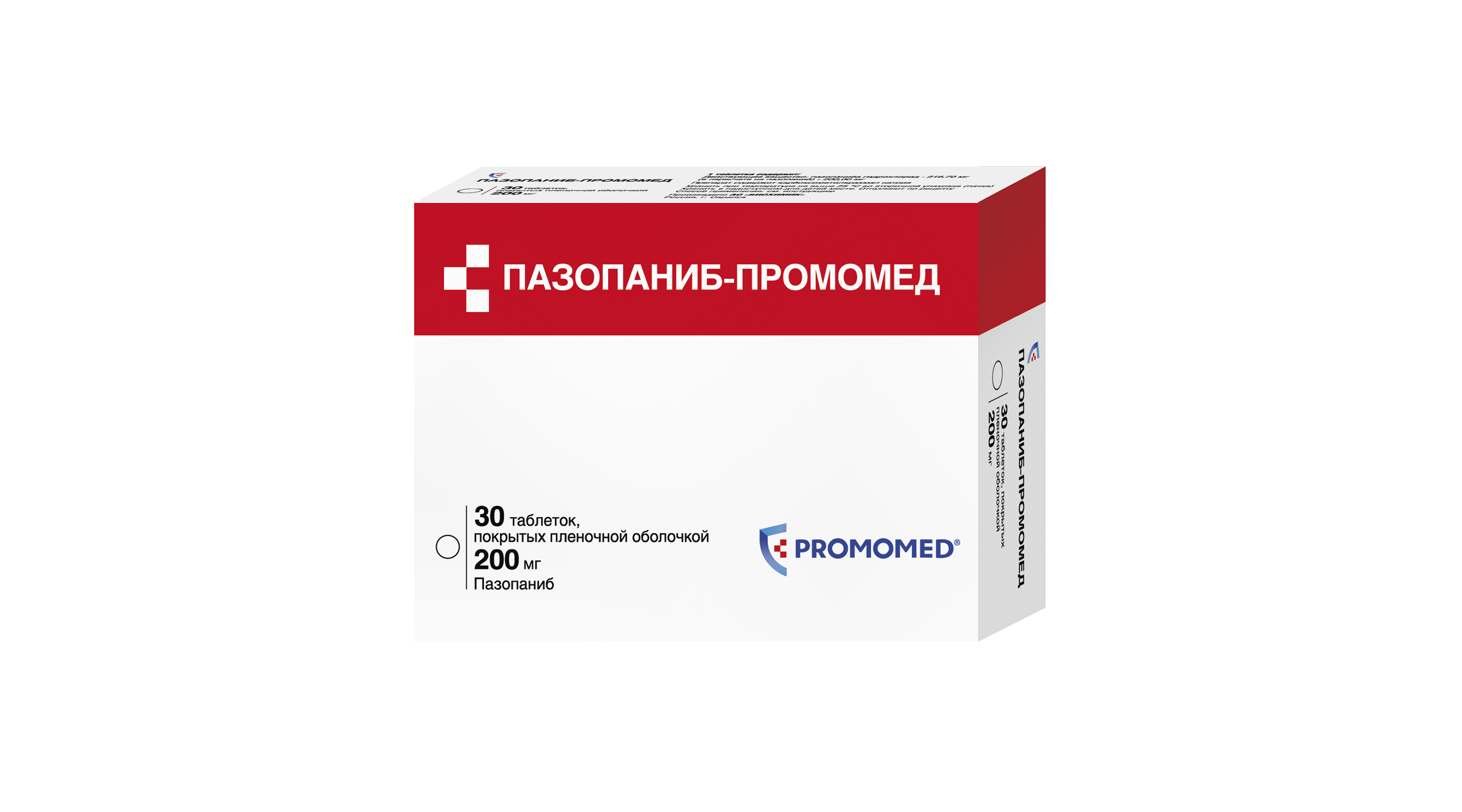

about the product
Dosage 200 mg:The tablets are round, biconvex, and film-coated in pink. In the cross-section, the core is white or almost white.
Dosage 400 mg: oval, biconvex, film-coated tablets in white. In the cross-section, the core is white or almost white
Specifications
Name
PAZOPANIB-PROMOMED
Dosage form
FILM-COATED TABLETS
Nosological classification
Antitumor drugs
INN
PAZOPANIB
Dosages
200 mg; 400 mg
ATC code
L01EX03
Active substance
pazopanib
Pharmacotherapeutic group
Cancer drugs
use
The
recommended dose of Pazopanib-Promomed is 800 mg orally once a day. The drug Pazopanib-Promomed should be taken at least one hour before or two hours after a meal. Tablets should be swallowed whole, without violating their integrity (do not break, do not chew). If you miss taking the next dose of the drug, the missed dose should be taken only if there are more than 12 hours left before the next scheduled dose.
Dose selection
Depending on individual tolerance, the daily dose of the drug can be reduced or increased in increments of 200 mg, while the maximum daily dose should not exceed 800 mg. Special patient groups
Elderly patients
There is no need to adjust the dosage regimen and frequency of administration in patients over the age of 65.
Patients with impaired renal function
Due to the low degree of renal excretion of pazopanib and its metabolites, impaired renal function does not significantly affect the pharmacokinetics of pazopanib, therefore, no dosage adjustment is required in patients with creatinine clearance> 30 ml/min.
There is no experience of using pazopanib in patients with severe renal impairment or in patients undergoing peritoneal dialysis or hemodialysis, and therefore the use of Pazopanib-Promomed in such patients is contraindicated.
Patients with impaired liver function
The safety and pharmacokinetics of pazopanib in patients with pre-existing liver dysfunction have not been fully established. No dose adjustment is required in patients with mild hepatic impairment (determined by ALT activity and bilirubin concentration).
In patients with moderate hepatic impairment, the dose of Pazopanib-Promomed should be reduced to 200 mg per day.
There is insufficient data on the use of pazopanib in patients with impaired liver function, accompanied by an increase in total bilirubin concentration more than three times higher than ULN (with any ALT activity), and therefore the use of Pazopanib-Promomed in such patients is contraindicated.
Dose selection
Depending on individual tolerance, the daily dose of the drug can be reduced or increased in increments of 200 mg, while the maximum daily dose should not exceed 800 mg. Special patient groups
Elderly patients
There is no need to adjust the dosage regimen and frequency of administration in patients over the age of 65.
Patients with impaired renal function
Due to the low degree of renal excretion of pazopanib and its metabolites, impaired renal function does not significantly affect the pharmacokinetics of pazopanib, therefore, no dosage adjustment is required in patients with creatinine clearance> 30 ml/min.
There is no experience of using pazopanib in patients with severe renal impairment or in patients undergoing peritoneal dialysis or hemodialysis, and therefore the use of Pazopanib-Promomed in such patients is contraindicated.
Patients with impaired liver function
The safety and pharmacokinetics of pazopanib in patients with pre-existing liver dysfunction have not been fully established. No dose adjustment is required in patients with mild hepatic impairment (determined by ALT activity and bilirubin concentration).
In patients with moderate hepatic impairment, the dose of Pazopanib-Promomed should be reduced to 200 mg per day.
There is insufficient data on the use of pazopanib in patients with impaired liver function, accompanied by an increase in total bilirubin concentration more than three times higher than ULN (with any ALT activity), and therefore the use of Pazopanib-Promomed in such patients is contraindicated.
Help
Package leaflet
Pazopanib is a potent inhibitor of a variety of tyrosine kinases, including tyrosine kinases of endothelial growth factor receptors (VEGFR)-1, -2, -3, platelet growth factor receptors (PDGFR)- alpha and beta, fibroblast growth factor receptors (FGFR)-l and -3, stem cell factor receptor (Kit), and T-cellular kinase induced by interleukin 2 (Itk), leukocyte-specific protein tyrosine kinase (Lck), and macrophage colony stimulating factor receptor (c-Fms) tyrosine kinase. In vitropazopanib inhibits ligand-induced autophosphorylation of VEGFR-2, Kit and PDGFR-β. In vivo pazopanib inhibits VEGF-induced phosphorylation of VEGFR-2 in animal lung tissues, angiogenesis in animals, and the growth of certain human tumor xenografts in animals. The values of the inhibitory concentration of 50% (IC50) upon binding of pazopanib to the receptors of vascular endothelial growth factor, platelet growth factor and stem cell factor are 10, 30, 47, 71, 84 and 74 nmol/l, respectively.
- Treatment of advanced renal cell carcinoma (RCC)
- Treatment of advanced soft tissue sarcoma (CMT) (cromegastrointestinal stromal tumors and liposarcoma) in patients who previously received chemotherapy
Symptoms
Dose-limiting toxicity (grade 3 fatigue) and grade 3 hypertension were observed in 1 out of 3 patients who took 2000 mg and 1000 mg of pazopanib per day, respectively. It is possible to increase the above-described adverse events.
Treatment
Symptomatic. Only a small part of pazopanib can be eliminated by
hemodialysis, because the degree of its binding to plasma proteins is high.
For more information about all possible adverse reactions and the frequency of their occurrence, see the instructions in the corresponding table.
- Hypersensitivity to pazopanib or any other component of the drug.
- Severe liver dysfunction (due to insufficient data).
- Severe renal impairment (due to insufficient data).
- Simultaneous use with other antitumor drugs.
- Pregnancy and lactation period.
- Children's age (due to insufficient data).
Inducers or inhibitors of the cytochrome P450 system (isoenzyme CYP3A4)
Based on in vitro studies, it can be assumed that the oxidative metabolism of pazopanib in human liver microsomes proceeds mainly with the participation of the isoenzyme CYP3A4, with minor involvement of the isoenzymes CYP1A2 and CYP2C8. Thus, inhibitors and inducers of the CYP3A4 isoenzyme may alter the metabolism of pazopanib.
Inhibitors of the CYP3A4 isoenzyme, P-glycoprotein (P-gp) and breast cancer resistance protein (BCRP)
Pazopanib is a substrate for the isoenzyme CYP3A4, P-gp and BCRP. Concomitant use of pazopanib (400 mg once daily) with a potent inhibitor of the CYP3A4 and P-gp isoenzymes, ketoconazole (400 mg once daily), sequentially for 5 days led to an increase in the average AUC(0-24) and Cmax of pazopanib by 66% and 45%, respectively, according to
compared with the use of pazopanib without concomitant medications (400 mg once a day for 7 days). With an increase in the dose in the range from 50 mg to 2000 mg, the Cmax and AUC values of pazopanib increased to a lesser extent than in proportion to the dose. Thus, in most patients, after reducing the dose of pazopanib to 400 mg once daily in the presence of potent inhibitors of the CYP3A4 isoenzyme, systemic exposure to pazopanib
it corresponded to that when using pazopanib at a dose of 800 mg once a day without simultaneous use of concomitant drugs. However, in some patients, the systemic exposure of pazopanib may increase compared to that with its individual use at a dose of 800 mg.
(For more information about the entire list, see the instructions in the leaflet)
Registration certificate holder
JSC Biochemist, Russian Federation
15A Vasenko St., Saransk, Republic of Mordovia, 430030
Manufacturer
JSC Biochemist, Russian Federation
Address: 15A Vasenko St., Saransk, 430030, Republic of Mordovia
Phone number: +7 (8342) 38 03 68
Email: biohimic@promomed.pro
Internet address: promomed.ru
Organization that accepts consumer claims
JSC Biochemist, Russian Federation
Address: 15A Vasenko str., Saransk, 430030, Republic of Mordovia
Phone number: 8 800 222 95 63; 8 800 777 86 04 ( around the clock)
Email: hot_line@promomed.pro
Store at a temperature not exceeding 25 °C. Store in the original packaging (pack) to protect from light. Keep out of reach of children.
2 years. Do not use after the expiration date.
They are available on prescription.
our partners
Where to buy