about the product
The dosage is 12.5 mg: solid gelatin capsules No. 4, yellow body, yellow lid, opaque, cylindrical in shape with hemispherical ends. The contents of the capsules are a mixture of powder and granules of orange color.
The dosage is 25 mg: solid gelatin capsules No. 3, white body, white lid, opaque, cylindrical in shape with hemispherical ends. The contents of the capsules are a mixture of powder and granules of orange color.
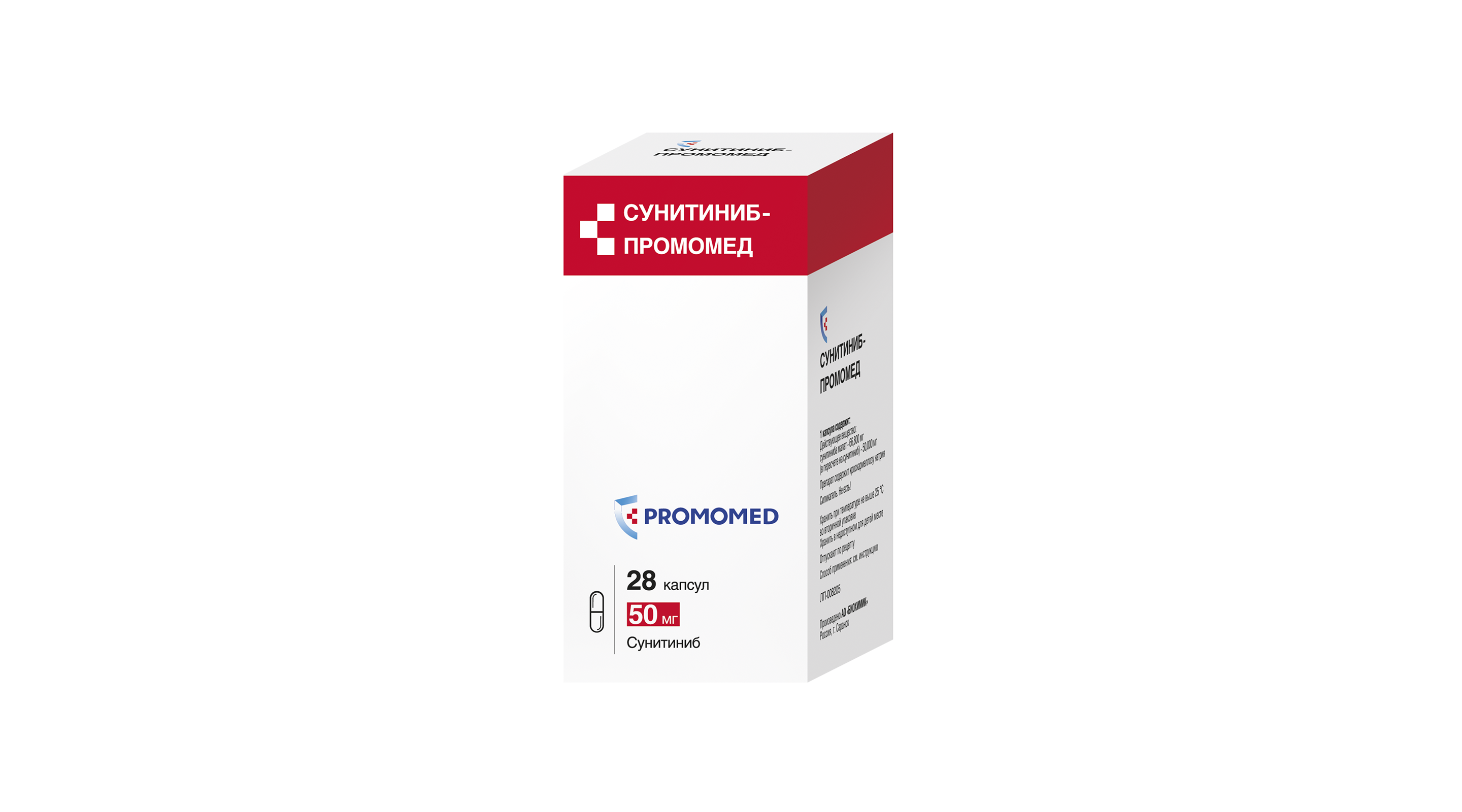
The dosage is 50 mg: solid gelatin capsules No. 2, blue body, blue lid, opaque, cylindrical in shape with hemispherical ends. The contents of the capsules are a mixture of powder and granules of orange color.
Specifications
Name
Sunitinib-Promomed
Dosage form
Capsules
Nosological classification
Antitumor drugs
INN
Sunitinib
Dosages
12.5 mg; 25 mg; 50 mg
ATC code
L01EX01
Active substance
Sunitiniba malat
Pharmacotherapeutic group
Cancer drugs
use
Treatment with Sunitinib-Promomed should be carried out under the supervision of a doctor who has experience working with antitumor drugs. At the beginning of each cycle of therapy with Sunitinib-Promomed, a complete analysis of hematological parameters should be performed.
Dosage regimen
GISO in the absence of the effect of imatinib therapy due to resistance or intolerance
The recommended dose of the drug is 50 mg per day orally for 4 weeks, followed by a break of 2 weeks (4/2 mode). The full cycle of therapy is therefore 6 weeks.
Common and/or mPCR in patients who have not previously received specific treatment or in the absence of effect from cytokine therapy
The recommended dose of the drug is 50 mg per day orally for 4 weeks, followed by a break of 2 weeks (4/2 mode). The full cycle of therapy is therefore 6 weeks.
Inoperable or metastatic, highly differentiated NEC in adults with disease progression
The recommended dose of the drug is 37.5 mg daily without interruption.
Adjuvant therapy in patients at high risk of RCC recurrence after nephrectomy
The recommended dose of the drug is 50 mg per day orally in the 4/2 mode for nine 6-week cycles (approximately 1 year).
Method of application
Inside. Taking the drug does not depend on food intake.
Help
Package leaflet
Sunitinib is able to simultaneously inhibit the receptors of various tyrosine kinases (RTK) involved in the processes of tumor growth, pathological angiogenesis and metastasis formation. Sunitinib has been found to be an inhibitor of platelet-derived growth factor receptors (PDGFRa and PDGRFß), vascular endothelial growth factor receptors (VEGRF1, VEGRF2 and VEGRF3), stem cell factor receptor (KIT), Fms-like tyrosine kinase-3 receptor (FLT3), colony stimulating factor receptor (CSF-1R) and neurotrophic factor receptor glial factor (RET). The primary metabolite exhibits activity comparable to that of sunitinib in biochemical and cellular research methods.
- Inoperable and/or metastatic gastrointestinal stromal tumors (GISO) in the absence of effect from imatinib therapy due to resistance or intolerance;
- advanced and/or metastatic renal cell carcinoma (mPCC) in patients who have not previously received specific treatment;
- advanced and/or metastatic renal cell carcinoma (mPCC) with no effect from cytokine therapy;
- inoperable or metastatic highly differentiated neuroendocrine tumors of the pancreas in adults with disease progression;
- Adjuvant therapy in patients at high risk of recurrence of renal cell carcinoma (RCC) after nephrectomy.
There is no specific antidote. In case of overdose, treatment is symptomatic. If necessary, it is recommended to induce vomiting or gastric lavage. There are reports of overdose cases. In some of these cases, adverse reactions have been reported that correspond to the safety profile of the drug.
Summary of the security profile
The most serious adverse reactions (in some cases fatal) associated with sunitinib were: renal failure, heart failure, pulmonary embolism, perforation of the gastrointestinal tract and bleeding (including bleeding from the respiratory tract, bleeding in the gastrointestinal tract, tumors, urinary tract, hemorrhages in the brain).
The most common adverse reactions of all degrees (which were noted during registration studies involving patients with RCC, GISO and NEOPJ) were decreased appetite, taste disorders, hypertension, fatigue, gastrointestinal disorders such as diarrhea, nausea, stomatitis, dyspepsia and vomiting, as well as skin discoloration and palmar syndrome.- plantar erythrodysesthesia. These symptoms may decrease as therapy continues. Hypothyroidism may develop while taking sunitinib. Hematological disorders (e.g., neutropenia, thrombocytopenia, and anemia) are among the most common adverse drug reactions.
(For more information about all possible adverse reactions, see the leaflet)
- hypersensitivity to sunitinib or other components of the drug;
- severe liver failure;
- pregnancy and lactation;
- children's age (the efficacy and safety of sunitinib in children has not been established).
Medication, boosting the concentration of sunitinib in plasma The combined use of a single dose of sunitinib with an inhibitor of the CYP3A4 isoenzyme, ketoconazole, increasesmax and AUC0-∞ The sunitinib complex and the main active metabolite increased by 49% and 51%, respectively, in healthy volunteers. The use of Sunitinib-Prommed in combination with other inhibitors of the CYP3A4 isoenzyme (for example, ritonavir, itraconazole, erythromycin, clarithromycin or grapefruit juice) may lead to an increase in the concentration of sunitinib.
Medication, reducing the concentration of sunitinib in plasma The combined use of a single dose of sunitinib with an inducer of the CYP3A4 isoenzyme, rifampicin, reducesswing and AUC0-∞ in healthy volunteers, by 23% and 46%, respectively. The use of Sunitinib-Prommed in combination with other inducers of the CYP3A4 isoenzyme (for example, dexamethasone, phenytoin, carbamazepine, rifampicin, phenobarbital or St. John's wort) may lead to a decrease in the concentration of sunitinib.
The holder of the registration certificate
JSC Biochemist, Russian Federation
15A Vasenko St., Saransk, 430030, Republic of Mordovia
Manufacturer
JSC Biochemist, Russian Federation
Address: 15A Vasenko St., Saransk, 430030, Republic of Mordovia
Phone: +7 (8342) 38 03 68
Email: biohimic@promomed.pro
Internet address: promomed.pro
Organization that accepts consumer claims
JSC Biochemist, Russian Federation
Address: 15A Vasenko St., Saransk, 430030, Republic of Mordovia
Phone number: 8 800 222 95 63; 8 800 777 86 04 ( around the clock)
Email: hot_line@promomed.pro
Store at a temperature not exceeding 25 °C. Store in the original packaging (pack) to protect from light. Keep out of reach of children.
3 years. Do not use after the expiration date.
They are available on prescription.
our partners
Where to buy