
about the product
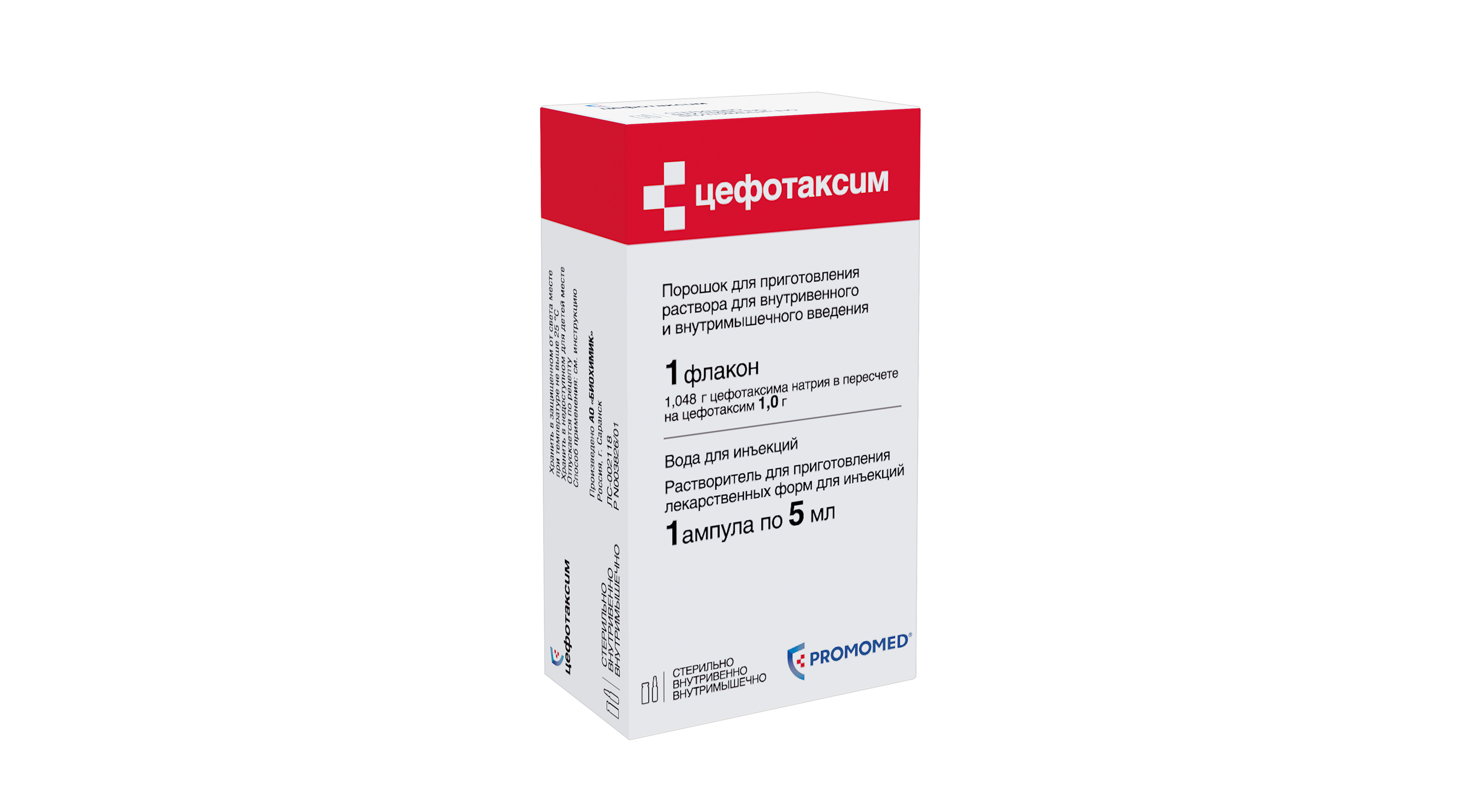
Powder for preparation of a solution for intravenous and intramuscular administration.
Powder
The powder is white to slightly yellow in color.
Solvent
Water for injection, solvent for preparation of dosage forms for injection
Colorless transparent liquid.
Specifications
Name
Cefotaxime
Dosage form
Powder for solution preparation for intravenous and intramuscular administration
Nosological classification
Antibacterial drugs of systemic action
INN
Cefotaxime
Dosages
1 g
ATC code
J01DD01
Active substance
cefotaxime
Pharmacotherapeutic group
Antibacterial
use
Always use the drug in full accordance with the recommendations of your doctor. If in doubt, consult your doctor.
Recommended dose:
The dose of the drug and the duration of treatment are determined by the attending physician, depending on the severity and type of infection and your condition.
Adults
For infections of mild and moderate severity – 1 g every 12 hours. The dose may vary depending on the severity of the infection, the sensitivity of the pathogen, and your condition.
For severe infections Your doctor may prescribe a higher dose (up to 12 grams per day, divided into 3-4 injections).
For infections caused by Pseudomonas spp., the daily dose should be more than 6 g .
For the treatment of gonorrhea The drug is administered in a dose of 1 g once intravenously or intramuscularly.
In order to prevent infections before surgery (from 30 to 90 minutes before the start of the operation), 1 g is administered intravenously or intramuscularly.
When performing a cesarean section at the time of applying clamps to the umbilical vein, 1 g of the drug is injected intravenously, then after 6 and 12 hours, 1 g is re-injected intravenously or intramuscularly.
Patients with renal insufficiency
Tell your doctor if you or your child have impaired kidney function or if you are undergoing blood purification from harmful substances (hemo- or peritoneal dialysis). The doctor will adjust the dose.
Use in children and adolescents
Children over 12 years of age and with a body weight of 50 kg or more
The dosage regimen for children over 12 years of age and with a body weight of 50 kg or more corresponds to the dosage regimen for adults.
Children under 12 years of age and weighing up to 50 kg
The usual dose is 100-150 mg per kilogram of body weight per day, divided into 2-4 injections.
For very severe infections, the dose can be increased to 200 mg per kilogram of body weight per day.
Newborns
The dose is 50 mg per kilogram of body weight per day, divided into 2-4 injections.
For severe infections, a dose of 150-200 mg per kilogram of body weight per day, divided into 2-4 injections.
Route and (or) method of administration
The drug Cefotaxime can be administered:
• as an injection directly into a vein;
• by intravenous drip (infusion);
• intramuscularly.
The Cefotaxime solution will be prepared and then administered by a qualified healthcare professional.
Help
Package leaflet
The active ingredient of the drug Cefotaxime is cefotaxime, which belongs to beta-lactam antibiotics from the subgroup of cephalosporins of the third generation. It is intended for the treatment of human infections caused by bacteria sensitive to the drug. The drug is administered parenterally, that is, intravenously or intramuscularly.
Cefotaxime is indicated for the treatment of infections caused by microorganisms sensitive to cefotaxime in adults and children:
• Respiratory tract infections;
• urinary tract infections;
• severe diseases that develop when infectious agents or their toxins enter the bloodstream (septicemia, bacteremia);
• inflammation of the inner lining of the heart (endocarditis);
• Intra-abdominal infections such as abdominal inflammation (peritonitis);
• inflammation of the meninges (meningitis, except meningitis caused by special pathogens called listeria) and other infections of the central nervous system;
• infections of the skin and soft tissues;
• infections of bones and joints.
Prevention of infections after surgical operations on the gastrointestinal tract, urological (including prevention of infections after endoscopic resection of the prostate gland) and obstetric and gynecological operations.
If there is no improvement or you feel worse, you should consult a doctor.
If you are undergoing treatment in a hospital, it is unlikely that you will receive more medication from a doctor or nurse than is prescribed. A doctor or nurse will monitor your treatment and check the dose of the drug you are receiving.
Symptoms
A symptom of overdose is encephalopathy (brain malfunction), which is manifested by seizures and impaired consciousness.
Treatment
If you are concerned that you are taking too much of the drug, tell your doctor or other medical professional immediately. In emergency cases, the attending physician will take the necessary measures to treat the overdose.
Like all medications, Cefotaxime can cause undesirable reactions, but they do not occur in everyone.
Discontinue use of Cefotaxime and seek immediate medical attention if any of the following symptoms occur: serious adverse reactions:
The frequency is unknown (based on the available data, it is impossible to estimate):
• an allergic reaction that may be accompanied by swelling of the face, eyelids, lips, tongue, and/or throat, which may cause difficulty breathing (angioedema);
• fainting or loss of consciousness, sudden decrease in blood pressure, respiratory disorders, pale bluish, cold, moist skin (anaphylactic shock/anaphylactic reactions);
• cough, wheezing, feeling of lack of air (bronchospasm).
Severe adverse reactions may occur when using Cefotaxime. Please inform your doctor immediately if you notice the following symptoms::
Infrequently (may occur in no more than 1 person out of 100):
• Fever, chills, headache, muscle pain, and skin rash that develop shortly after starting treatment with cefotaxime for infections caused by spirochaetes, such as tick-borne borreliosis (Lyme disease). This condition is known as the Yarish-Gerksheimer reaction. The symptoms usually last from several hours to one day.
The frequency is unknown (based on the available data, it is impossible to estimate):
• severe skin rash, redness of the skin, severe itching, blistering, peeling and swelling of the skin, inflammation of the mucous membranes, including the mouth, eyes, genitals, accompanied by bleeding (Stevens-Johnson syndrome, toxic epidermal necrolysis);
• target-like lesions on the skin and mucous membranes (erythema multiforme);
• progressive skin rash, often with blisters or damage to the mucous membranes (acute generalized exanthematous pustulosis);
• frequent loose stools (diarrhea) with an admixture of blood that occurred during or after treatment with the drug, abdominal pain by type of cramps, fever (pseudomembranous colitis);
• impaired brain function (encephalopathy) (for example, impaired consciousness, impaired motor activity);
• drowsiness, nausea, lack of appetite, weakness, decreased urine output per day (no more than 600 ml) (acute renal failure).
Other possible adverse reactions that may occur when using Cefotaxime.
Often (may occur in no more than 1 person out of 10):
• pain at the injection site during intramuscular injection.
Infrequently (may occur in no more than 1 person out of 100):
• decrease in the number of white blood cells (leukopenia) in the total blood count;
• an increase in the total blood count of a certain type of white blood cell called eosinophils (eosinophilia);
• decrease in the total blood count of the number of cells responsible for coagulation – platelets (thrombocytopenia);
• diarrhea (diarrhea);
• changes in the biochemical analysis of blood indicating impaired liver function (elevated levels of alkaline phosphatase (ALP), elevated levels of aspartate aminotransferase (AST), elevated levels of alanine aminotransferase (ALT), elevated levels of lactate dehydrogenase (LDH), elevated levels of gamma glutamyltransferase (GGT)) or increased concentrations of bilirubin;
• rash;
• itchy skin;
• the appearance of blisters on the skin, accompanied by severe itching (urticaria);
• kidney problem, which may be manifested by an increase in creatinine concentration in the urine. Patients receiving antibiotics called aminoglycosides at the same time are more likely to have kidney problems.;
• fever;
• inflammatory reactions at the injection site, including inflammation of the vein at the injection site (phlebitis), including the formation of a blood clot (thrombophlebitis).
Do not use Cefotaxime:
• if you are allergic to cefotaxime;
• if you are allergic to other cephalosporins (cephalosporins include antibiotics such as cefazolin, cefadroxil, cephalexin, ceftriaxone, cefepime, and others).
When using lidocaine solution (local anesthetic) to prepare a solution for intramuscular administration, contraindications to lidocaine use should be considered.
Do not use Cefotaxime solutions containing lidocaine.:
• if you are allergic to lidocaine or other local anesthetics of the amide type;
• if you have severe cardiac arrhythmias caused by intracardiac blockages, but no artificial pacemaker has been installed.;
• if you have severe heart failure;
• if your child is less than 2.5 years old (intramuscular injection).
Cefotaxime solutions containing lidocaine should under no circumstances be administered intravenously.!
Detailed information about contraindications to the use of lidocaine is provided in
instructions for medical use or leaflet for lidocaine.
Tell your doctor that you are taking, have recently taken, or may start taking any other medications.
In particular, tell your doctor if you are taking any of the following medications:
• Probenecid (used to treat gout or elevated uric acid levels in the blood), which slows down the excretion of cefotaxime through the kidneys. This can lead to elevated concentrations of cefotaxime in the blood that persist for a long time.
• Antibiotics are aminoglycosides, as simultaneous use with Cefotaxime may have an adverse effect on the kidneys.
• Furosemide (a diuretic), as concomitant use with Cefotaxime may have adverse effects on the kidneys.
The holder of the registration certificate
Russian Federation
PROMOMED RUS LLC
Address: 13 Mira Avenue, building 1, office 13, Moscow, 129090
Phone: +7 (495) 640-25-28
Email: reception@promomed.pro
Manufacturer
Russian Federation
JSC "Biochemist"
Address: 15A Vasenko St., Saransk, 430030, Republic of Mordovia
Reporting of adverse reactions
Russian Federation
Federal Service for Healthcare Supervision
Address: 109012, Moscow, Slavyanskaya square, 4, building 1
Phone number: +7 800 550 99 03
Email: pharm@roszdravnadzor.gov.ru or npr@roszdravnadzor.gov.ru
Website in the Internet information and telecommunication network: www.roszdravnadzor.gov.ru
Keep the drug out of the reach of children.
Do not use the drug after the expiration date (shelf life) indicated on the carton after "Good before".
The expiration date is the last day of the given month.
Medication
Store at a temperature not exceeding 25 ° C. Store in the original packaging (pack/box).
Solvent kit Water for injection, solvent for preparation of dosage forms for injection
Store at a temperature not exceeding 25 ° C. Store in the original packaging (pack).
Do not freeze.
Do not dispose (pour) the drug into the sewer. Ask the pharmacy employee how to dispose (destroy) drugs that are no longer needed. These measures will help protect the environment.
If you are pregnant or breastfeeding, assume that you have become pregnant, or are planning to become pregnant, consult your doctor before using the drug.
Your doctor will consider the benefits of Cefotaxime treatment for you compared to the risks for your child.
Pregnancy
Do not use Cefotaxime during pregnancy.
Breastfeeding
If you are breastfeeding, your doctor will recommend that you stop breastfeeding while using Cefotaxime.
The drug can cause dizziness, seizures, confusion, impaired consciousness, and movement disorders. If these adverse reactions occur, refrain from driving vehicles and working with mechanisms.
our partners
Where to buy